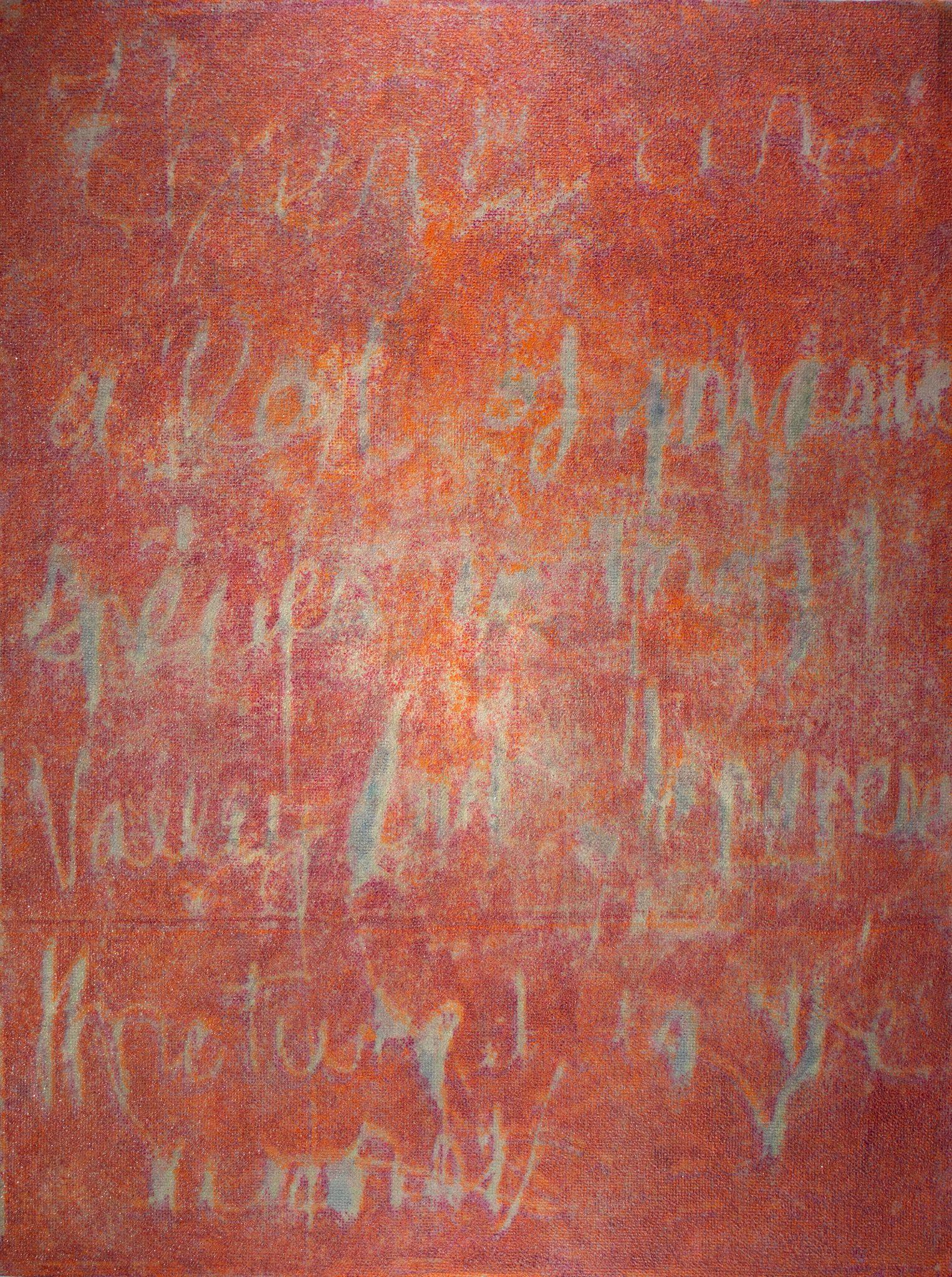
In The Tale of Lost Waters at Five Points Arts in Connecticut, Susan Hoffman Fishman exhibits seven vertical scrolls resembling satellite imagery. Four are layered in deep, earthy browns—recalling land formations and dry blood—pressing against vibrant blues reminiscent of water. The bodies of water seem suspended between presence and disappearance, drifting toward an undefined space—a light or a void.
Oskar Landi was born and raised in Italy. In 1998, he moved to New York to pursue art, arriving with two tools: a saxophone and a camera. Over time, the camera became the better instrument for making a living. With several years of experience as a photo assistant in Europe, he adapted to New York’s photography industry, building a basic commercial and editorial client base that allowed him to sustain himself while continuing to explore the medium’s possibilities.
If you haven’t visited the little paradise up in the Bronx called Wave Hill recently, now is the time to go there, not only to experience the beautiful gardens but to see exhibitions that are not to be missed, one of them being Stephanie Beck’s Bough. Beck, who has always been a risk-taking sculptor, either building cities out of paper or manipulating wood into gravity-defying constructions, speaks with me about her latest body of work constructed from materials found at Wave Hill and bringing to light crucial environmental issues beautifully and elegantly. This is the last week to see the show, which runs through December 1st, 2024.
Hovey Brock, A Golden Spike for the Anthropocene, 2020, 30” x 40”, acrylic media on panel
Hovey Brock was a member of the Catskill Art Society (CAS) before its rebranding as the Catskill Art Space. Originally a low-key regional arts center, the transformation began under the guidance of Executive Director Sally Wright. In October 2022, Wright inaugurated the new exhibition halls, featuring on-loan installations by Sol Lewitt and James Turrell, signaling CAS’s ambition to bring world-class arts programming to Livingston Manor. This initiative marked a significant milestone in the cultural revival sweeping the entire Catskill region, with CAS playing a pivotal role. “Since so much of my work is about the Catskills, I am thrilled to have this opportunity to show my pieces at CAS, especially in the company of fellow artists Daniella Dooling and Valerie Hegarty,” Brock says.
It consists of nature walks and community interventions in the gallery and various locations throughout the Bay Ridge community from April 15 through June 17, 2023. Art Spiel will feature a series of interviews related to this project throughout its duration, here with artist Nancy Nowacek.
Kate Dodd, E. J. McAdams & Jennifer McGregor enjoy haiku installed in the ceiling lamps by E.J. and Jimbo Blachly as part of Kate’s Bay Ridge Tree Collection at the Bay Ridge Branch of the Brooklyn Public Library. Photo courtesy of E. J. McAdams.
Bay Ridge through an Ecological Lens is a multi-faceted public art exhibition hosted by Stand4 Gallery and presented in collaboration with ecoartspace
It consists of nature walks and community interventions in the gallery and various locations throughout the Bay Ridge community from April 15 through June 17, 2023. Art Spiel will feature a series of interviews related to this project throughout its duration, here with curator Jennifer McGregor.
A central theme in my Crazy River project has been highlighting the emotional toll of the climate crisis by putting under a microscope, so to speak, my own feelings about not only the impacts of the crisis but the knowledge that humans’ actions are the cause. This series of three on-line essays, thought experiments if you like, expands that project to change the POV to non-human actors that are inextricably bound with the habitat in the Western Catskills: the black-legged or deer tick (Ixodes scapularis), the white-tail deer (Odocoileus virginianus), and Japanese knotweed (Reynoutria japonica). All three have seen their habitat change dramatically through climate change and human interventions. Using my imagination and research, I try to enter the umwelt of all three species, an impossible task, as Thomas Nagel pointed out in “What Is It LIke to Be a Bat,” for which artistic license may give us the best chance to accomplish. My intentions in doing so fall along three axes: theoretical, aesthetic, and spiritual, dimensions all essential to my own art practice. Part III looks at the umwelt–a term normally applied only to animals whose use in this instance I will explain later–of Japanese knotweed from the perspective of the Vajrayana, or Tantric Buddhism.
Tip of the Iceberg by Amanda Maciuba, Jen Morris, Jessica Tam, dimensions variable, vinyl on glass and wall, 2021
This month, I have a wonderful interview with three artists for you. Amanda Maciuba, Jen Morris, and Jessica Tam are all visual artists working in different mediums. However, they share a fascination with how ecological language (surge, spike, wave, etc.) has worked its way into news reports’ descriptions of large phenomena such as crowds, pandemics, and political movements. They recently closed a show at the A.P.E., Ltd. Gallery in Northampton, Massachusetts titled WAVE/SURGE/SPIKE.
In the Beginning There Was Only Water: Panels 19-22, each panel 30″ x 15″, acrylic, oil pigment stick and mixed media on paper, 2021
While some of us taught ourselves to bake sourdough bread or to mend socks during the pandemic, the American painter and arts writer Susan Hoffman Fishman plunged herself into her studio and emerged, a year later, with a revised creation story. The result: a magnificent, nearly 50-foot (15 meters) opus entitled In The Beginning There Was Only Water. Currently on exhibit at theFive Points Gallery in Torrington, Connecticut through December 19, 2021, In The Beginning There Was Only Water reframes the biblical creation myth – in which “man” was granted “dominion” over all the Earth’s plants and animals – into a new, non-human-centric story.
During the Coronavirus pandemic, Art Spiel is reaching out to artists to learn how they are coping.
Jaanika Peerna at her pandemic era studio
Jaanika Peerna is an Estonian-born artist and educator living and working in New York since 1998. Her work encompasses drawing, installation, and performance, often dealing with the theme of transitions in light, air, water and other natural phenomena. For her performances she is often involves the audience in participatory reflection on the current climate meltdown. Her art practice stems from the corporeal experience of our existence and reaches towards enhanced awareness of the fragility, interconnectedness and wonder of all life.