Notice: Function WP_Object_Cache::add was called incorrectly. Cache key must not be an empty string. Please see Debugging in WordPress for more information. (This message was added in version 6.1.0.) in /www/artspiel_344/public/wp-includes/functions.php on line 6131
Gabriela Vainsencher in the studio with “Mom”, 2021
Gabriela Vainsencher works in photography, video and drawing, while merging all of these forms in her porcelain sculptures. Her sculptures and wall reliefs are as far off the smooth perfection we traditionally associate with porcelain – twisted forms merge into each other or repel, forming a fiery existential dance that sometimes invokes symbiosis and sometimes pulling apart.
“Brie Ruais: Movement at the Edge of the Land”, installation of exhibition, courtesy The Moody Center for the Arts and albertz benda gallery. Photo by Nash Baker
Brie Ruais [b. 1982, Southern California] lives and works in Brooklyn, New York. She received her MFA from Columbia University’s School of the Arts in 2011. Ruais’ movement-based practice is legible through the scrapes, gouges, and gestures embedded in the surfaces and forms of the ceramic works. Each sculpture is made with the equivalent of her body weight in clay, resulting in human-scale works that forge an intimacy with the viewer’s body. Through her immersive engagement with clay, Ruais’s work generates a physical and sensorial experience that explores a new dialogue between the body and the earth.
The mid-career survey exhibition, Sue Havens: Cull, at the Marjorie Barrick Museum of Art includes the Florida based artist’s paintings and ceramic work since 2016. Curator Jason Lazarus describes the recent “pandemic paintings” as “a compressor, kettle, and prism” of the artist’s work from the past twenty years. Havens outlines her goal most simply as a question: “What is it to search for form?”
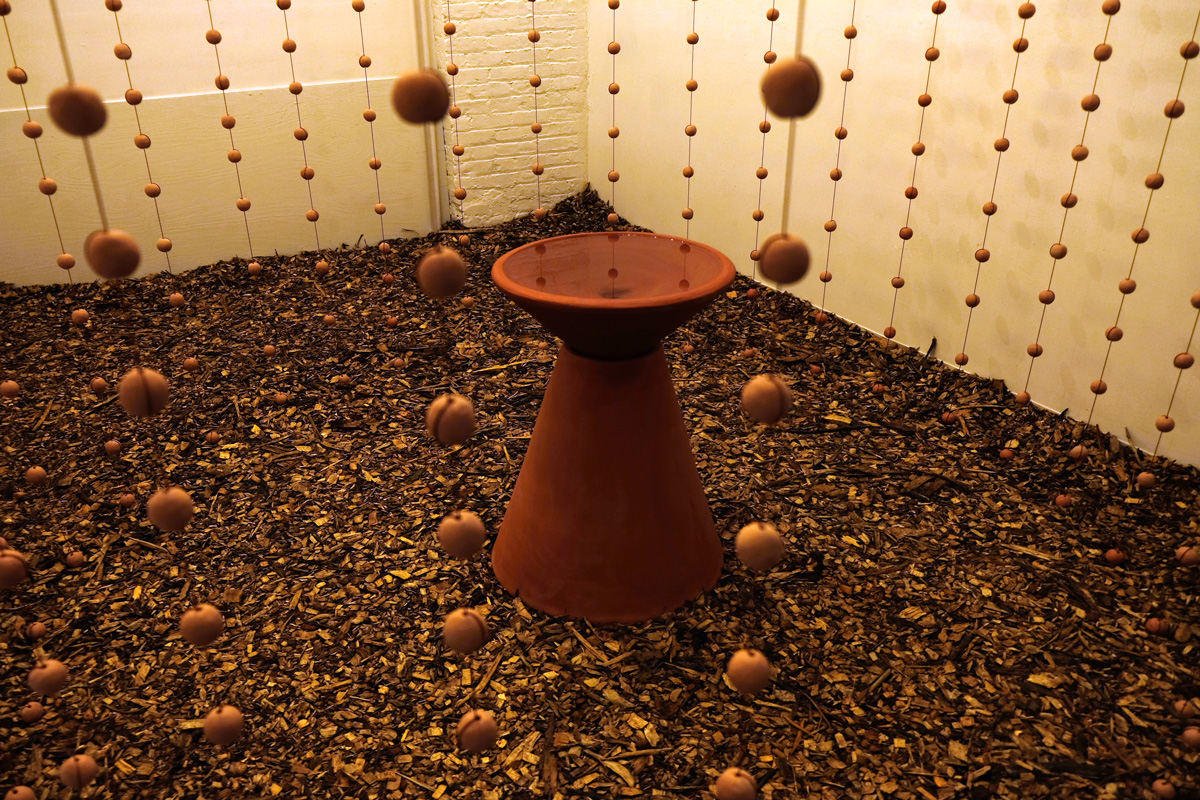
Installation view. “To Ripple with Water” at The Border Project Space, 2021. Image courtesy of the artist
In unstable and changing times, haunted by a pandemic and conflicts unfolding worldwide, the installation by artist Bel Falleiros creates an introspective space that allows us to pause and reflect on how we relate to ourselves and the environment. Presented at The Border Project Space and curated by Jamie Martinez, “To Ripple with Water” is an invitation to be present, to disconnect from the frantic times we live in, and reconnect to our bodies and to the earth, in a quietly performative experience.
The group exhibition Form or Function at ArtPort Kingston features works of various media, exploring the relationship of objects in between contemporary art, design and craft with an attempt to blur the lines and create dialogue. The exhibition overall prompts a question – “Looking at everyday images, objects, tools and materials, we have very diverse emotional bonds with them. An artist creates a dialogue with their materials, providing intentions. Is it an object’s form, their history, or the story we create that attracts us?”
The show is curated by Laurie De Chiara, featuring works by Chuck von Schmidt, Karen Jaimes, Staveley Kuzmanov, Traci Johnson, Barbara Marks, Ellie Murphy, Courtney Puckett, Jim Osman, Rachel Urkowitz and Gabriele Hamill, Inna Babaeva, Clemens Kois, Sophi Kravitz, Christina Kruse, Jeanne Atkin, Kathleen Vance, Erika DeVries, and Rodger Stevens. The show runs through June 6th.
From left to right: Spandita Malik ‘Salwar-Kameez on Clothesline’ 2021 Sun-printing, Phulkari silk thread embroidery on Khaddar fabric, 32 x 40 inches ; Geuryung Lee‘The movement’ 2019 Drypoint on paper 18 x 24 inches; Sofia Luisa Suazo Monsalve ‘Post-photographic landscape #1,2,3’ 2019 Digital chromogenic print on paper, 9 x 18 inches; j.p.mot ‘Stool + boogey’ 2017 Mixed media, 7ft x 5ft x 6ft; Hyun Jung Ahn ‘Blanket Windows’ 2021 Felt and linen, 72 x 62 inches
SHIFTING SANDS is a group exhibition showcasing the creative breadth of 20 artists from the 2020 New York Foundation for the Arts Immigrant Artist Mentoring Program. Each of these artists has crossed physical borders, leaving one part of the world for another – in doing so, they hold space for various identities and shifting realities. From this common experience emerges unique perspectives on identity, belonging, home, memory, hope and resilience. Many of the pieces exhibited were created during the pandemic. They express the rollercoaster of emotions, the shifting states of being, and new possibility.
Jen Dwyer, Stay Hard & Soft, Ceramic sculpture, 2020
In the several years preceding the pandemic, Jen Dwyer completed her MFA in Ceramics at the University of Notre Dame, exhibited at Miami Context in 2019 as well as in back-to-back iterations of Spring/Break, and saw her work profiled by Forbes and Architectural Digest. Then, when the rapidly increasing toll of the coronavirus caused the collective art world to press pause on what promised to be yet another whirlwind year, she took the slower pace of life as an opportunity to embrace deeper introspection in her studio practice. This newfound creative intuition wove its way into the production of her most recent collection of sculptures and paintings, which the artist recently debuted at Wassaic Project in New York.
“Popular Jewelry” featuring Arkadiy Ryabin, Johanna Stroebel, Clarissa Hurst, and Ann Treesa Joy, on September 26, 2020, photo credit to Adam Golfer, image courtesy of P.A.D.
The artist-run Project Art Distribution (better known as P.A.D. or @project_art_distribution on Instagram) hosts day-long outdoor exhibitions on versatile packing 72”x80” pads. Set up in Soho, one of New York’s art and retail hubs, the padded surfaces become the metaphorical and physical exhibition space of the usual pristine white cube galleries. Unlike the current Soho rental clientele of luxury brands and gallery spaces, P.A.D. has no walls. Lacking barriers in more than one way, the sidewalk gallery provides the public, the artists, the curators, and the organizational collaborators a welcomed openness to art and discussion. The project creates an ongoing network that ever-expands its community.
Upon entering In My Room, Susan Carr’s solo show at LABspace in Hillsdale, NY, my senses are overloaded in the best way by the colorful and tactile work. The gallery is teeming with an impressive amount of work that fills the walls, floor, and pedestals. As I walk around, I am greeted with the fond familiar smell of fresh oil paint— thick, bold, and often mixed on the surface. This application is important to the overall sensation of Carr’s work. It makes me grasp the immediacy and the confidence that are necessary to make the work. Squeezing paint directly from the tube onto the canvas requires a commitment from the artist and Carr dives in headfirst to create paintings of zombies, clowns, self-portraits, and eyeballs.
Melissa Stern is an artist, working in mixed materials and across genres. She is interested in ideas that are simultaneously funny and dark- that is, “work that might make you smile or laugh, but with a wee bit of discomfort,” as she puts it. Much of her work of recent years focuses on home and childhood and the ways in which our childhoods and our memories haunt our lives. She works in clay, found objects, wood, metal collage and various drawing materials. Her goal is that the materials she uses are at the service of the ideas. On a different note she says, “I am an only child, raised by older parents who were first generation Americans. My mother desperately wanted to be ‘American’. My father was very connected to his European heritage. This push and pull; between belonging and being an outsider has profoundly influenced my life as an artist.” Melissa Stern is participating in Domestic Brutes at Pelham Art Center.