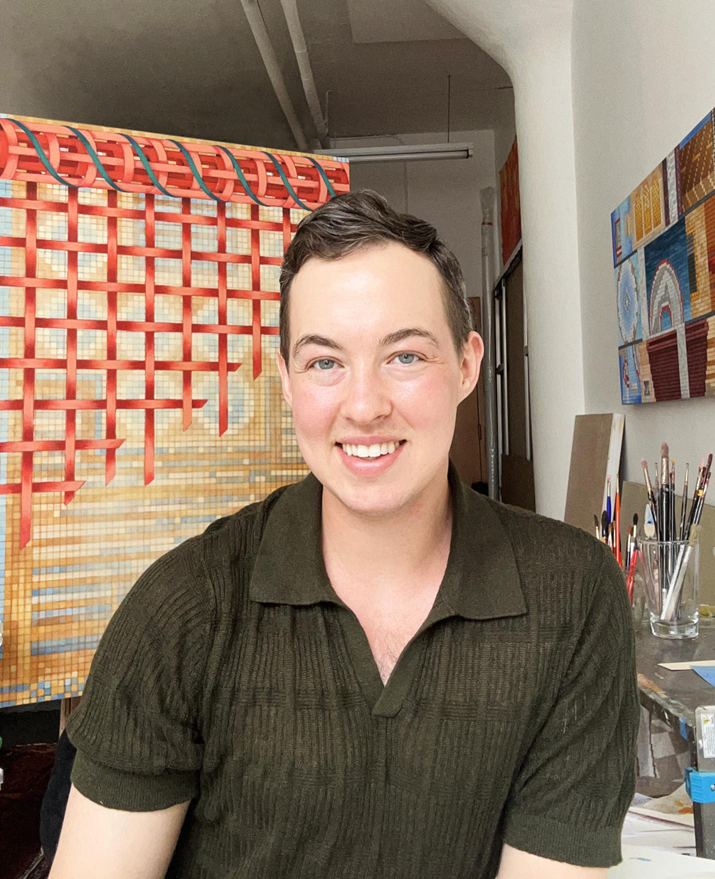
The paintings in James Gold’s solo show, Infinite Scroll, act as intermediaries between past, present and future. These glimmering grids at Morgan Lehman gallery toggle between his deep reverence for history and his active aesthetic imagination. Talking with the painter about his wider practices in collaged artist books and archeological renderings revealed new means of perception and applications of art-making.
The 2025 art fair season has descended upon us, and with it comes a myriad of activities. Amidst the hustle and bustle of moving around the cities to see what’s on view, there were many standouts at this year’s presentations at the Armory and Art on Paper.
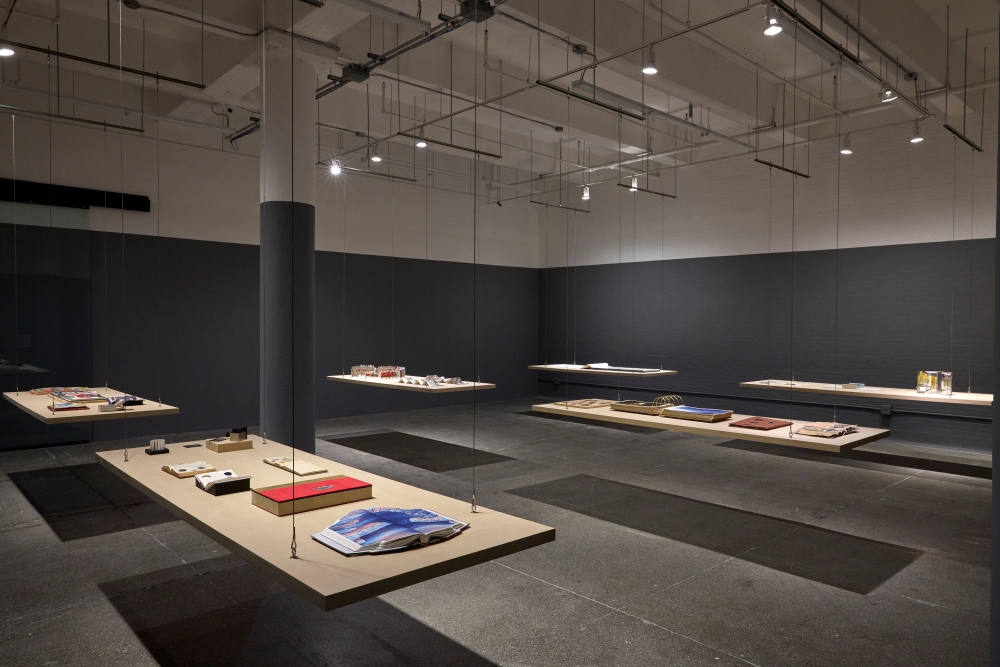
There is a hidden gem on view at Mana Contemporary in Jersey City—an art book group show of 15 artists carefully curated by the directors and curators of Monira Foundation and Mana Contemporary. The exhibition unfolds across two rooms. In the first space, the viewer encounters a dimly lit room of suspended tables uniquely designed by Kele McComsey. On each table, there is a carefully curated display of artist books—a rare opportunity to view this uniquely expressive form of art. During the run of the show, the curators periodically shift some books, while others are welcome to be handled. This is an incredible opportunity to see artist books and experience their magic. Blurring the lines between book and sculpture, these magnetic art objects have always been a curatorial challenge. They are meant to be experienced, unlike most other art pieces.
Gallerist Eniko Imre with the artwork (photo by David X. Levine). Artwork: Katie Heller Saltoun, Endless Ordering (Virgin Mary Cupboard), 2020, ink wash & pen on paper, 51.5” x 77”
Throughout her fifteen years in the art world—spanning fairs, events, curation, and non-profits—Eniko Imre built her career on a deep passion for art, a close-knit community of artists, and the trust many placed in her discerning eye. A year after COVID, during a visit to Tribeca, she was struck by the neighborhood’s burgeoning gallery scene. “Small one-woman spaces were thriving alongside multinational galleries, the blocks around Broadway bursting with art,” she recalls. Inspired by this wave of reemergence, she felt determined to carve her own path and be a part of it—on her own terms.
Marina Kassianidou, A Partial History, 2024. Installation view, NARS Foundation, Brooklyn, NY, USA. Courtesy of the artist and NARS Foundation
During her solo exhibition at the NARS Foundation, artist Marina Kassianidou spoke with Mary Annunziata, who previously curated Marina’s work, A Partial History, as part of the inaugural Immigrant Artist Biennial in 2020. In her exhibition at NARS, Marina presents new work inspired by her grandmother’s collection of 19th and 20th-century schoolbooks from Cyprus. On display are four photographs of selected pages from these books, four artist’s books that recreate the full original texts, and four large sculptural drawings. The show celebrates a call and response with ancestors’ material history, showcasing Marina’s time-intensive artistic process in which she works with surfaces found in her surroundings, such as walls, floors, fabrics, paper, and screens, and experiments with ways of marking that respond to the surface’s appearance, use, or history.
The artist withBig Yellow, 18″ x 11″ x 7.5”; ceramic; 2017. Photo Credit: Linda Cunningham
Ten years ago, Judy Hoffman became enthralled with clay and hand-building. The current exhibition Evolvers and Wildtypes at the Long Island City Sculpture Space is her first solo show of these ceramic sculptures. Hoffman’s ceramics’ imagery and forms tap into a previous installation work made from sculpted paper pulp, natural materials, and man-made debris. Paper clay techniques permit the bonding of wet clay to fired forms, enabling the construction of diverse configurations. These components are conjoined to initiate a dialogue between organic and mechanical elements, yielding imagery that defies expectation. The artwork evolves through a rhythm of construction and deconstruction, encapsulating cycles of creation, deterioration, and renewal. Viewers are meant to encounter an elemental rawness, surprise, and a touch of humor.
“There’s always time to do what you really want. When I had children, I worked when everybody went to bed, after 11pm. I would set up at the kitchen table and clean it very well before I would start.”
–Luchita Hurtado
Remember in the darkest, most locked down days of the pandemic, when all of us were stuck within our own walls, and many of us had kids at home too? And we found ourselves having to resort to making work at the kitchen table in between the cracks of work and school. Well, it got me thinking that this was nothing new to the history of making art: a history that wants us to think that its entire timeline is full of swaggering guys in big New York City lofts, hands-on-chins, undistracted by life’s mundanity. But, in fact, the reality of being an artist is rife with personal stories of people who had to make it work. They, like us, squeezed making art in between the oven timer and the kids’ nap, or in between the hours of a demoralizing 9-5. And quite frankly, those artists that find a way to eke through those tough years of limited space and time are the artists that have the swagger that impresses me the most.
BTS (Beating Tadumi Station), 2014, video projection, immersive installation at BMoCA, photo by Tricia Rubio
Denver-based, Korean American artist Sammy Lee’s solo exhibition at the Emmanuel Art Gallery explores motherhood, domesticity, immigration, and prejudice through installation, artist books, performance art, and sculptures. The artist is using a multitude of textures and mediums that re-contextualizes familiar objects, ritual, and scenes into art. Remind Me Tomorrow opens May 25, during Asian American and Pacific Heritage (AAPI) month to celebrate Asian culture and speak out against the alarming bigotry manifested against Asian people. The exhibition runs through July 15th, 2021.
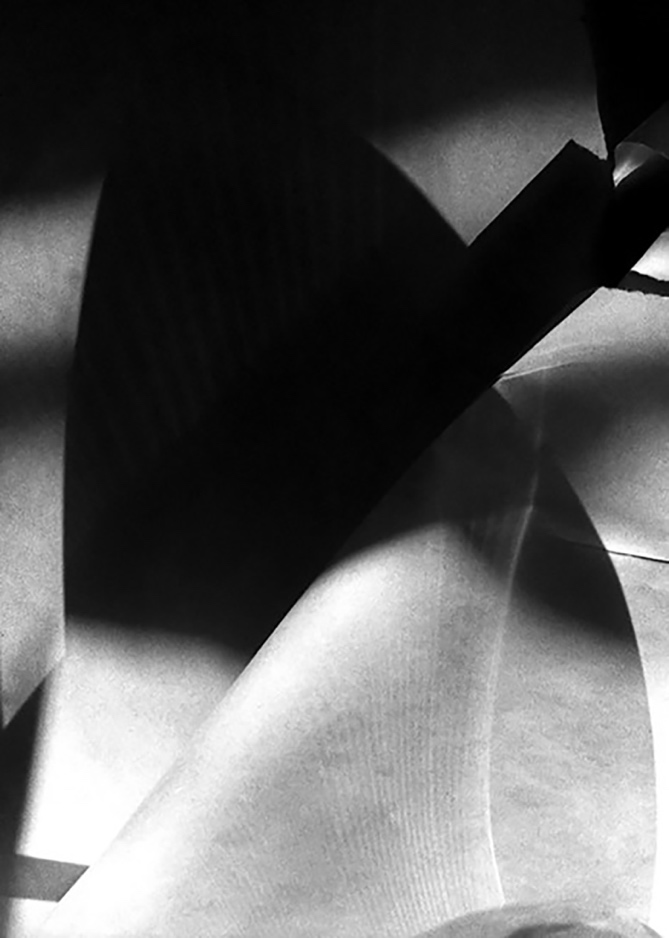
Soft Black Petal, silver gelatin print, 20×24”, 1985
Paulette Myers-Rich ‘s photography-based art books and prints reference abstracted landscapes where industry and nature intersect. Paulette Myers-Rich has consistently focused her gaze on the very moment of transformation in both interior and exterior spaces, when a place, nature, history, altogether shift. The artist shares with Art Spiel how she has developed her practice, her notions on book making, and how she sees her role as an artist today.
Hema Bharadwwaj and Eileen Ferara, USPS Art Project Collaboration
When the lockdown began in mid-late March in New York City, artist Christina Massey felt it was too soon for her to address the pandemic in her own artwork. While desperately trying to process the disorienting news shifting by the hour, she was noticing an uptick in posts calling for people to save the Postal Service by buying stamps. The idea for the USPS Art Project came to her with immediate clarity. An artist starts making an artwork and mails it to a partner to complete and vice versa.