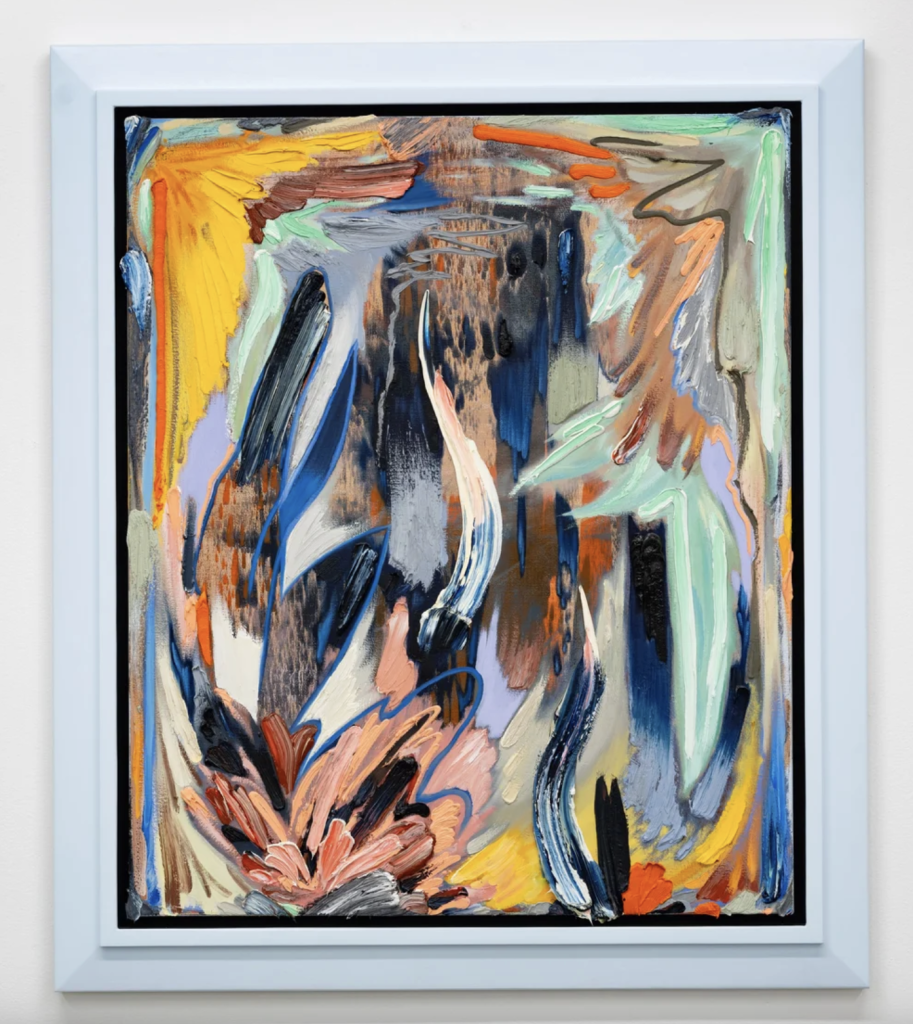
Jonathan Syme Coaxes Spirit from Matter at Royale Projects

Jonathan Syme, Receding, Shy Daylight, 2024, oil on canvas in artist frame, 43” x 37”. Courtesy of Royale Projects

Jonathan Syme paints like someone coaxing spirit from matter—a phrase that sounds mystical until you’re standing in front of the work, where it becomes simply descriptive. As restless as they seem, his canvases don’t argue or perform; they resonate, like a vibration passed through the soles of your feet. Thick skeins of paint are unearthed, revealing strata in a geologic dig of intuition. There’s a kind of archaeology to the gesture: gouges, stains, and eruptions of impasto build a type of sedimentary record, chronicling attention. The eye slows down, and with it, thought.

Continue reading “Jonathan Syme Coaxes Spirit from Matter at Royale Projects”

Jenny Holzer’s Hypocrisy

Opinion
Walls of the Guggenheim Museum bathed in a purple glow. A scrolling LED text installation winds up the ramps of the Guggenheim Museum, displaying texts written and curated by the artist, leading to a blue sky beyond the oculus.
Installation view, Jenny Holzer: L: right Line, May 17-September 29, 2024. Solomon R. Guggenheim Museum, New York. @2024 Jenny Holzer, Artists Rights Society (ARS), New York, Photo: Filip Wolak

“I want people to concentrate on the content of the writing and not ‘who done it.’ I want the work to be of utility to as many people as possible. And I think if it were attributed to me, it would be easier to toss.”

Quote by Jenny Holzer from Art21

Recently, I wrote an opinion piece on the suspect politics of Maurizio Cattelan’s show at Gagosian Gallery — it questioned why successful artists who make political claims for their work do not use their privilege to engage in direct political commentary and action rather than critique by analogy. I’m not suggesting they need to engage in social practices like Mel Chin or Tania Bruguera; I think artists like Cattelan can be more direct in their criticism or more like Theaster Gates, who acknowledges the contradictions and privilege that comes with his success to the degree that he openly differentiates between museums and institutional exhibits that permit him to experimentation and his gallery exhibits that afford him market engagement. Meanwhile, while those works have an implied politic, he is an activist who focuses on community development, which is realized through his Chicago-based Rebuild Foundation, which is a platform for cultural development and neighborhood transformation. This multifaceted approach enables Gates to navigate and influence both the art world and broader societal issues without collapsing one into the other.

Continue reading “Jenny Holzer’s Hypocrisy”

Whisperings from the Wormhole with @talluts

Some Thoughts About Portrait Artist of the Year, a British TV Show

Portrait Artist of the Year 2019 Season 5, Episode 8, Sky Arts; Artist: Rebecca Train, Sitter: Daniel Lismore

One of my guilty pleasures is binge-watching creativity reality shows, especially from the UK. We’ve got the Great Pottery Throw Down, where the judge, a great hulking potter in overalls with a Wallace and Gromit face, bursts into tears every time he sees a beautifully made ceramic. There’s Blown Away, a glass-blowing show with lots of macho folk blowing glass sweatily. And there’s Landscape Artist of the Year. But my all-time favorite is Sky Art’s Portrait Artist of the Year.

Continue reading “Whisperings from the Wormhole with @talluts”

Whisperings from the Wormhole with @talluts

Let’s Keep Thinking About Pollyanna

A painting of a person leaning on a table

Description automatically generated
Woman in a Window (detail) 1957 Richard Diebenkorn, Collection Buffalo AKG Art Museum / Gift of Seymour H. Knox, Jr., 1958

Have you heard about a mysterious note found among Richard Diebenkorn’s papers that he made for himself in his later years? It’s a motivational studio credo titled Notes to Myself on Beginning a Painting and is comprised of ten tips. All ten are fascinating to think about, but number eight is the most enigmatic:

“Keep thinking about Pollyanna.”

Continue reading “Whisperings from the Wormhole with @talluts”

Amy Talluto Describes a Munch Print – Towards the Forest II

Meditation on a Munch Print

A painting of a person hugging a forest

Description automatically generated
Towards the Forest II 1915 Color Woodcut, 20 x 25.5 in (65 x 50 cm), (Exhibited at Edvard Munch: Trembling Earth at the Clark Art Institute)

“An eyewitness described Edvard Munch supervising the print of a colour lithograph in 1896. He stood in front of the stones on which the head of a masterpiece was drawn. He then closed his eyes tightly, stabbed the air with his finger, and gave his instructions. ‘Print… grey, green, blue, brown.’ Then he opened his eyes and remarked, ‘Now it’s time for a glass of schnapps.’ The whole performance, including the air of melodrama and that shot of spirits, was highly characteristic.”

-Martin Gayford, The Spectator

Continue reading “Amy Talluto Describes a Munch Print – Towards the Forest II”

Amy Talluto Describes an Elisabeth Condon Painting – Dusk, 2023

A blue and brown abstract painting

Description automatically generated
Elisabeth Condon, Dusk, 2023, acrylic and mediums on linen, 30 x 21 inches

Amy Talluto’s reflections on a painting by Elisabeth Condon were initially presented in an interview with the artist in podcast episode 59 for Pep Talks for Artists. Elisabeth Condon is a frequent guest on the show, contributing to the series Elisabeth Condon Describes a Painting. In conjunction with Condon’s solo exhibition and participation in the Untitled fair, both with Emerson Dorsch Gallery in Miami,[LINK: https://emersondorsch.com/] Amy interviewed Elisabeth and described Condon’s Dusk, 2023, acrylic and mediums on linen, 30 x 21 inches, a painting included in her show. Dusk will be on view at the gallery from December 3, 2023, through February 3, 2024, in the exhibition Tempus Fugit.

Continue reading “Amy Talluto Describes an Elisabeth Condon Painting – Dusk, 2023”

Whisperings from the Wormhole with @talluts

Fear & Philip Guston
A painting of a chair

Description automatically generated
Philip Guston Head (detail), 1968 Oil on board, Courtesy of Museum of Modern Art © 2023 The Estate of Philip Guston

Born in 1913, Canadian American painter Philip Guston began his career in the 50’s in New York during the Abstract Expressionist movement. The Ab-Ex-ers were sweeping the country as the next great thing and developing a bit of a swagger. Painters everywhere were ditching representational painting for the new experimental style of pure abstraction, and Guston was no exception. Well-esteemed and well-reviewed, he was a part of the in-crowd. Everyone loved the guy.

Continue reading “Whisperings from the Wormhole with @talluts”

Manet and Degas as Realists

Opinion
The Metropolitan Museum of Art

Technically, Edouard Manet (1832–1883) and Edgar Degas (1834–1917 are not Impressionists; instead, they are Realists whose works owe a debt to Gericault, Goya, and Daumier and the invention of photography. Unlike Monet, who sought solace and inspiration in nature, which can be seen as a reaction to the urbanization associated with the rise of the bourgeoisie, Manet and Degas instead embraced the industrialization and urbanization driven by bourgeois economic interests. They were unconcerned with the dehumanizing effects of rapid technological advancement. Realism is aimed at depicting scenes and subjects based on the everyday lives of ordinary people.

Continue reading “Manet and Degas as Realists”

It’s Pablo-matic: Picasso According to Hannah Gadsby

Opinion
Left: Pablo Picasso, 1920. © 2023 Estate of Pablo Picasso / Artists Rights Society (ARS), New York. Right: Hannah Gadsby, 2018. (Photo: Alan Moyle).
Left: Pablo Picasso, 1920. @2023 Estate of Pablo Picasso / Artists Rights Society (ARS), New York. Right: Hannah Gadsby, 2018. (Photo: Alan Moyle).

In our current era where historical and critical thinking are on the wane, one can’t complain about a show being ahistorical, but one can be faulted for lacking a cogent dialogue. Consequently, though mashing things together can produce interesting results, the parts must communicate with one another in a meaningful manner. Problematically, the exhibit, It’s Pablo-matic: Picasso According to Hannah Gadsby at the Brooklyn Museum resembles Gadsby’s stand-up comedy routine—it rambles from subject to subject, and in this case, its cohesion relies on the audience’s attempt to understand how it is all connected to the red-herring Picasso. Considering Gadsby has been put in the position of playing auteur in a medium she is unaccustomed to, one which is visual and not language-based, it might have been a more interesting exercise in a post-way of thinking to present solely the exhibition’s wall texts, or conversely just the works themselves without commentary rather than clinging to the conventions of theme based exhibitions.

Continue reading “It’s Pablo-matic: Picasso According to Hannah Gadsby”

Collage and Then Some: Vitamin C+

Book Review
Vitamin C+ Collage in Contemporary Art. Introductory essay by Yuval Etgar. Phaidon (back cover)

Recently released by Phaidon, Vitamin C+ is another noteworthy addition to the publisher’s boundlessly malleable series of anthological volumes gathering scores of artist profiles into luxuriantly illustrated, conceptually cohesive tomes. Medium, era, genre, or movement tend to be the organizational binders for these books, as might be expected, and they’re generally wonderful and inspiring as such. But they’re sometimes wonderful and inspiring in less obvious ways as well, furnishing readers with much more to delve into, reflect on, and revisit time and again.

Continue reading “Collage and Then Some: Vitamin C+”