Deanna Sirlin, Wavetable, installation view at 211 East 43rd Street, NYC, NY
Deanna Sirlin’s Wavetable, on view in the lobby of 211 East 43rd Street, New York, includes seven recent paintings, all 7 feet by 5 feet, arranged in a line that turns a corner. Produced between 2020 and 2023, at the height of the pandemic, the paintings in Wavetable offer an eye-popping meditation on connections. As the world went into lockdown and our interactions and connections with others were circumscribed, Sirlin explored interaction and connection through these paintings.
Ellsworth Kelly (1923-2015) is one of those artists whose status I’ve never understood. While he is held in high esteem by many, I’ve always questioned his significance. Don’t get me wrong, I like his work, but liking it doesn’t necessarily make it significant. His work is elegant, refined, and smart, and yet even in the 1950s-70s, it seemed conservative against the backdrop of Abstract Expressionism, Pop, and Minimalism. What made Kelly different from his peers was that when he was living and studying in Paris after World War2 on the GI Bill, while many of his fellow artists from the States were exploring lyric abstraction and L’informale, Kelly was looking at Art Concrete and had begun to make multi-canvas paintings.
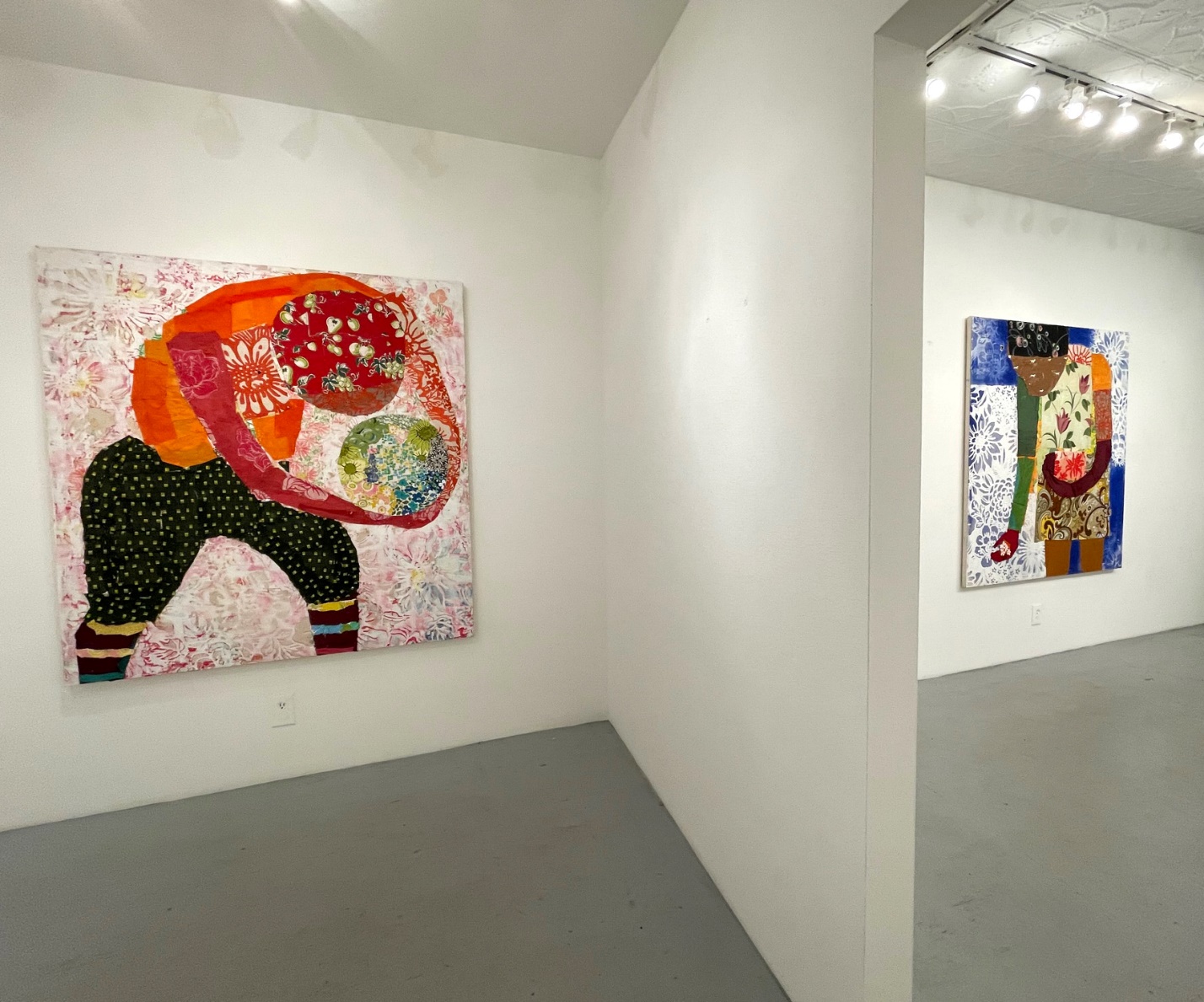
The exhibition PRESENT at 490 Atlantic gallery features nine paintings by Jessica Weiss. In this body of work, made during the pandemic, Weiss continues to combine wallpaper, silkscreened patterns, fabric, and paint—utilizing the optical and psychological power of these scraps from domestic life. Within the colorful and tactile surface, figures appear, and gesture becomes important. The exhibit opens Saturday February 25th, 5-8pm.
Diagram from the United States Geological Survey, Harvard.edu
What’s Your Golden Spike is the third in a series of three interrelated experimental pieces that combine graphics, text, and hyperlinks based on themes coming out of my Crazy River project, for which I gave an interview on this website on May 16th. Crazy River takes a wide-angle view of the climate crisis, ranging from my own climate grief to an in-depth focus on the many causes and effects of rapid environmental changes on the West Branch of the Neversink in Ulster County. In this piece I investigate the idea of the Catskills as a region, and an incongruous bundle of contradictions and coincidences. The Lands of Kats Kill weaves three timelines together: the geologic, the historical, and the personal. This structure repeats throughout my Crazy River project. The previous piece in this series, Invaders, took apart the idea of invasive species. The following will explore the concept of the Golden Spike in stratigraphy as fact and metaphor.
Portrait of Paul Behnke in the studio with Gloria’s Guardian, 2020, acrylic on canvas, 62 x 60 inches, photo courtesy of Robin Stout.
Paul Behnke is a champion of painting – and he does it with evident gusto. His paintings come from idiosyncrasies, life experience, and a process that begins as intuitive, mixed with periods of sharp critical gaze. His paintings have evolved from early contained and minimalistic bold-color geometries, to more recent chaotic forms and layered complexity, at times almost explosive.
Linnéa Gabriella Spransy in her studio with ‘Chronos’, an ink drawing on frosted mylar, laminated and partially suspended from the wall.
For LA based, multi-disciplinary artist Linnéa Gabriella Spransy, limits are the core subject. Her curiosity about science, philosophy, cultural theory, physics, history, theology and, as she puts it, “a healthy dose of science fiction”, has led her to notice patterns and contradictions in commonplace assumptions. For instance, the belief that unlimited freedom is the optimal state of being, an idea that is flatly contradicted by the fact that no one is absolutely free, as we are all bound by a certain era, language, and people in our lives. Furthermore, Spransy says, some would argue that knowledge itself is a limit, especially knowledge about the future. She is grappling with big questions such as—does knowledge that deals with predicting the behavior of systems prevent freedom? Do we live in a deterministic universe merely garnished with the illusion of autonomy, or do we live in a genuinely open one? Throughout her reading and experience in the studio, she began to suspect that limitations are not barriers to freedom, but rather gateways.
Previewing – with gallery founder and curator Catherine Fosnot
Fred Gutzeit (2021) Future Life Puzzle, Acrylic on paper on canvas, 72” x 72”
The Opening Fall Season at the Fosnot Art Gallery will showcase Fred Gutzeit’s body of works from 1966-2021. Although he began as a painter of found objects and landscapes, Fred Gutzeit has never been satisfied with capturing the realism we “see“ in nature. He has continually sought a realism through abstraction that would capture the hidden complexity of nature juxtaposed with a human search for structure. Musings about complexity and chaos theories, string theory, mathematics modeling, and current scientific speculation about “multiverses” are employed as he explores consciousness, interaction, identity, and searches for structure. His bold use of color and dimensionality are wonderous and aesthetically pleasing allowing us to travel into the cosmos of his world.
Keisha Prioleau-Martin in her Bushwick studio with her paintings. Photo credit: Luke Lunsford 2021
The figures in New York City based painter Keisha Prioleau-Martin, become an essence of motion and emotion – exuding a sense of radical joy and playfulness, expressed through gestural brushstrokes and vibrant colors.
Matilda Forsberg, Feeding rite, 2019, acrylic on canvas, 48” x 36”
The Immigrant Artist Biennial (TIAB) is a volunteer, female-led, artist-run project. TIAB 2020 launched in March in New York City at Brooklyn Museum, and continued in September through December at EFA Project Space, Greenwood Cemetery, and virtually, presenting 60+ artists. This interview series features 10 participating artists.
Matilda Forsberg’s paintings explore heritage, identity, and the duality between the past and present. Her practice is inspired by the complexities of family and cultural tradition, and its emotional and psychological influence on individuals as independent beings. Originally from Sweden, Matilda Forsberg is based in Newark, NJ where she is currently a resident artist at Gallery Aferro. Her work has been exhibited across the country in New York, Los Angeles, Miami, and Portland (OR). She received her BFA in Painting from Pacific Northwest College of Art in Portland, Oregon.
During the Coronavirus pandemic, Art Spiel is reaching out to artists to learn how they are coping. This interview includes questions by both Art Spiel and Cultbytes as part of an Art Spiel x Cultbytes content collaboration.
Jane Swavely. Photographed by Peter Leece. All images courtesy of the artist if not otherwise stated.
Jane Swavely is a painter based in New York City. She studied at Boston University and the School of Visual Arts and was the recipient of a Ford Foundation Fellowship. Previously represented by CDS Gallery, she is currently a member of A.I.R gallery.