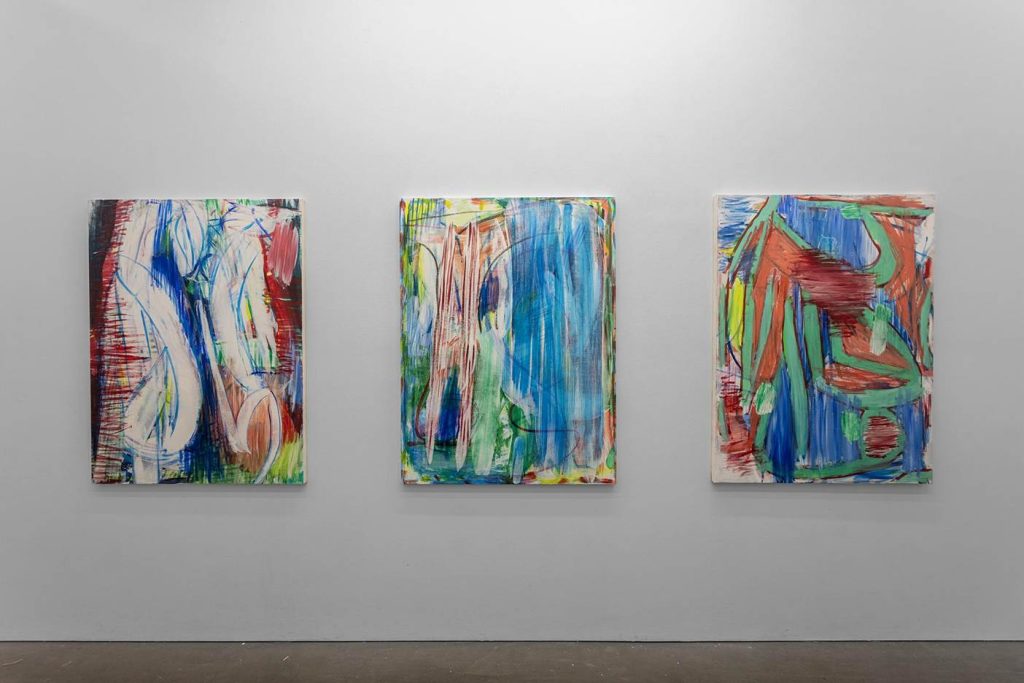
Johnny g mullen: Rehearsals in Movement

Installation View, (photo courtesy of Yanmei Jiang)

Walking into Peninsula gallery, an intimate space in the Two Bridges neighborhood, viewers are greeted with the energetic and punchy paintings in Johnny Mullen’s solo show- rehearsals in movement. Mullen has pinpointed his focus on layering paint, motion, and plays with both transparency and opacity in this new series. With the gallery itself being so intimate, you get a close and personal view of the works, a deeper look that proves very rewarding. Meandering from one painting to the next, each of a consistent size, you get to join mullen on his explorations within each piece. Expanding from his interest in color theory, Mullen has added an expanded investigation of layering and gesture within the pieces.

Continue reading “Johnny g mullen: Rehearsals in Movement”

The Bone and Muscle: A Conversation with Dona Nelson

In Dialogue
Dona Nelson in her studio

For decades, Dona Nelson has dissolved the formal boundaries of painting: refusing to apply pigment to just one side of the canvas, mounting the stretchers of her double-sided paintings on freestanding metal stands, and letting them occupy gallery floors like sculptural interlopers. In her current two-person show with Andrew Ross at Thomas Erben Gallery, however, the painter has ceded the floor space entirely, anchoring her three new works squarely to the wall.

Continue reading “The Bone and Muscle: A Conversation with Dona Nelson”

Sensuously Severe: Why Artists Call Don Voisine the Real Deal

Lift Off, 2024, Oil on wood panel, 24 x 20 inches

Don Voisine doesn’t do studio visits for Instagram. He doesn’t paint to please an algorithm. And he definitely doesn’t care if you call his new show “timely.” For over forty years, he’s explored the same visual territory—taut geometric abstraction with a personal twist—and somehow, he’s still finding fresh ground.

Continue reading “Sensuously Severe: Why Artists Call Don Voisine the Real Deal”

Contours and Strokes: Between Traditional and Contemporary Art Forms

Mika Kanemura performing at the gallery. calligrapher: Komei

When one looks at Franz Kline’s Abstract Expressionist paintings involving Gestural Abstraction, they cannot help but read a Chinese or Japanese character in calligraphic form. In fact, a relationship can be established between Kline’s “abstract” lines and marks from the calligraphic strokes of Sumi ink made by the masters of the traditional art form—Japanese calligraphy.

Continue reading “Contours and Strokes: Between Traditional and Contemporary Art Forms”

Erika Ranee: Feelings at Duck Creek

Erika Ranee, Sunset Beach, 2024, ink, shellac and oil pastel on canvas, 10 x 8 inches

I’ve been following Erika Ranee’s work since the mid-90s after I saw a handful of her works in person throughout a collector’s home. I recall a few key elements from that earlier work: medium to large scale, painted using a poured technique, and figurative or rather stenciled elements like references of figures and faces. Early on, Ranee’s work recalled a similarity to Donald Baechler’s. Think of a series of expressively painted applications layered upon one another and then codifying with a silhouette or stenciled image atop the coated process. I lost track of Ranee’s work for over a decade, then I came across it when she had a studio at The Marie Walsh Sharpe Art Foundation Program in 2011. I’ve been following her work and have had the pleasure of seeing it evolve steadily. Since my first encounter with the work, she has done away with a direct reference to figuration and seems to use titles to locate outside influences. Her work has grown, and her career is blossoming.

Continue reading “Erika Ranee: Feelings at Duck Creek”

Art Spiel Picks: Lower East Side in July 2024

HIGHLIGHT
Installation view, Shadowland, at Marc Straus, photo courtesy of the gallery

Summer 2024 shows in Lower East Side galleries offer many super solo and group exhibitions. We will highlight three that range from an inaugural show at a new NYC flagship gallery, a solo show of a veteran NYC artist, and a group show of Eastern European artists. That Dog in Me at Jupiter Gallery is a solo exhibition featuring seven new paintings by Travis Fish, who continues their exploration of fandom. Susan Eley Fine Art features the work of the late artist James Moore (1938 – 2013) in the second posthumous exhibition, Something Beautiful Happened. The group show at Marc Straus features Eastern European artists of the post-communist era and their responses to the rapid acceleration of technological development.

Continue reading “Art Spiel Picks: Lower East Side in July 2024”

Dreams of a Common Language: Elizabeth Duffy, Lu Heintz, and Anna McNeary In OVERLAP

Liz Maynard

Installation View: Left to Right Lu Heintz, Everything is Fiber: A New Lexicon, 2024 Graphite on paper Elizabeth Duffy Wearing / Ceremonial Costume for Gathering Rehill (1904-1972), 2023-2024, Unraveled worn braided rugs made into clothing, braided rug poncho with corn-on-the-cob holders, copper dandelion leaves, copper formed shoes, rug remnant; Anna McNeary, Common Set, 2024 Fabric, velcro, wooden rack Dimensions variable

The rhymes, homophones, and translations between the work of Elizabeth Duffy, Lu Heintz, and Anna McNeary are object manifestations of “Dreams of a Common Language.” The exhibition at Overlap Gallery in Newport, RI, offers up sweet and salty juxtapositions of textile, prints, sculptures, and installations of Providence-based artists. It takes its title from Adrienne Rich’s 1976 volume of poetry, which ruminates on the possibilities of life liberated from patriarchal constraints and the feminist community emerging from speech in common. Duffy, Heintz, and McNeary explore textile not just as a shared (and often gendered) medium but as a conceptual framework.

Continue reading “Dreams of a Common Language: Elizabeth Duffy, Lu Heintz, and Anna McNeary In OVERLAP”

Vom Abend, Joe Bradley at David Zwirner

A room with paintings on the wall

Description automatically generated
Installation view, Joe Bradley: Vom Abend, David Zwirner, New York, 2024. Photo courtesy of the gallery

The ten paintings in Vom Abend, Joe Bradley’s current show at David Zwirner, measure up to 93 x 120 inches and are all dated 2023-2024.  They are big and, with one exception, are in landscape orientations.  Framed with white oak strips, they have stately feel, yet they are hardly genteel.  They are full of crusty skins of dry paint that seem randomly attached to the surfaces. They are creased and folded.  They reek of oil paint.  And while the color is buoyant, joyous even, they are also dark.  Bradley isn’t afraid of black, and he explores shit brown with an alarming gusto. There are passages where the paint seems to have been aggressively ripped off the surface of the canvas, only to be tenderly painted over again.  There are staccato stippling marks.  There is erasure and heavy impasto in stretches.  Although this may sound like the paintings are heavily labored and full of themselves, they aren’t. And careful examination reveals worlds to explore.

Continue reading “Vom Abend, Joe Bradley at David Zwirner”

Accommodating the Object: Elizabeth Yamin and Bosiljka Raditsa at The Milton Resnick and Pat Passlof Foundation

Opinion
A room with art on the wall

Description automatically generated
Installation view. Photo courtesy of The Milton Resnick and Pat Passlof Foundation

The exhibition Accommodating the Object of paintings by Elizabeth Yamin and Bosiljka Raditsa is presented by The Milton Resnick and Pat Passlof Foundation in New York and was curated by William Corwin, who describes this exhibition as an intimate survey that offers the viewer an opportunity to compare the works of these two artists, who were active during the latter part of the twentieth century without attaining prominent careers.

Continue reading “Accommodating the Object: Elizabeth Yamin and Bosiljka Raditsa at The Milton Resnick and Pat Passlof Foundation”

­­Zahra Nazari: Interiors

In Dialogue
Image
Inside Out Oculus, 2022, acrylic on mylar, 36×45.5 in.

In her Interiors painting series, American Iranian-born painter Zahra Nazari draws on prominent features in classical Persian and Islamic architecture—decorative botanical motifs, arch, and particularly, iwan, the large, vaulted hall semi-enclosed and usually walled on three sides, with one end entirely open. Many scholars believe its origin can be traced back to the Parthian era. While looking at Nazari’s luminous surfaces, it may be interesting to keep in mind the dual role of the Persian arch—it serves both decorative and functional purposes—this richly decorated key aesthetic element in Persian architecture functions not only as an ornament but also as a structural support that provides stability. It is also designed to moderate the amount of sunlight that enters space, especially in iwans or other open spaces. Nazari’s frequent use of Mylar as a surface stirs a play on the notion of external and internal light, and simultaneously, her saturated color palette invokes a hot and arid climate with bright, sunlit days and crisp nights. Repetitive and rhythmical, these motifs coalesce into energetic, translucent, and luminous surfaces, evoking an interior space in flux. Zahra Nazari elaborates on her ideas and process in this interview with Art Spiel.

Continue reading “­­Zahra Nazari: Interiors”