Notice: Function WP_Object_Cache::add was called incorrectly. Cache key must not be an empty string. Please see Debugging in WordPress for more information. (This message was added in version 6.1.0.) in /www/artspiel_344/public/wp-includes/functions.php on line 6131
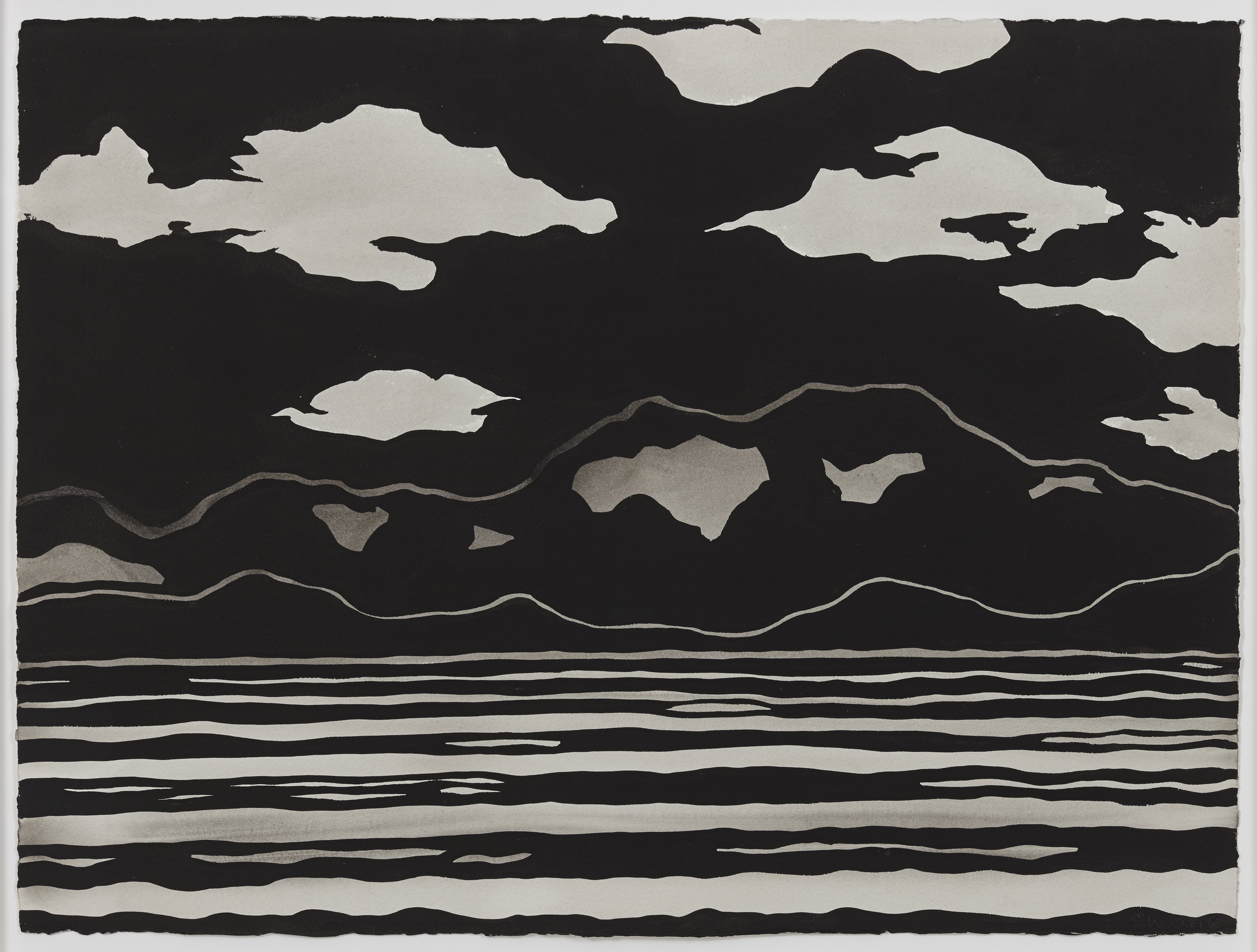
Eric Wolf, Mooselookmeguntic Lake, 2016, ink on paper 22” x 30”. Courtesy of Pamela Salisbury Gallery
Eric Wolf’s landscape paintings are made with ink on paper and reference nature—water, sky, trees. In their sharp light and dark shapes they resemble woodcut, linoleum prints or even highly contrasted black and white photographs, but the more you look at them, the immediacy of the painted ink comes through—from the artist’s direct observation of nature, through his mind, to his hand—in a magical transformation ink flowing on paper fibers becomes river and white floating shapes become clouds.
Installation view of The Agreement: Chromatic Presences, curated by William Corwin at Zürcher Gallery. Photo: Adam Reich. Courtesy of Zürcher Gallery NY/Paris.
I’ll start with a question: does a critic have an obligation to propose a solution to an enigmatic puzzle an exhibition might pose? What has led to this, is reading William Corwin’s catalog essay for The Agreement: Chromatic Presences, in which he ignores recounting the history of sculpture and color—deemed for a very long time to be irreconcilable like fish and cheese. It is now common knowledge, sculpture till the time of the renaissance was largely polychromed, but a neo-classical notion of purity and essentialism came to be imposed upon it to differentiate it qualitatively from painting. As a result, sculpture came to be limited to the colors of its materials—marble, bronze and wood. In the West, this formalism was institutionalized by the Enlightenment’s and was the excepted norm until the mid-20th century, when art’s traditional forms began to morph. Consequently, we must ask if there is a more contemporary issue concerning color and form at the heart of Corwin’s The Agreement: Chromatic Presences, and if so, what might it be?
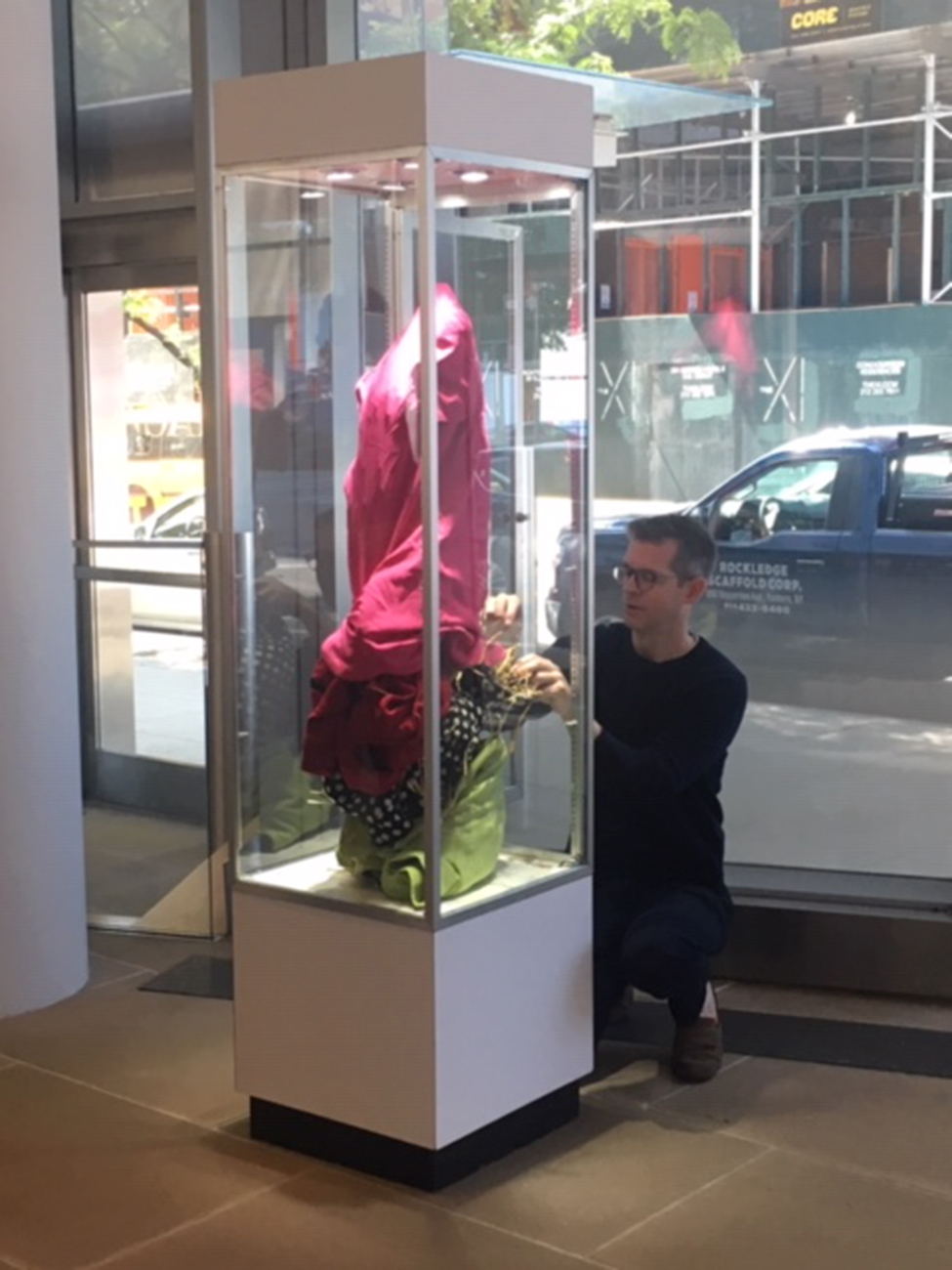
Jim Condron installing Close to You, Karen Condron’s clothes, straw, yarrow, 50 x 30 x 30 inches at Wings over Wall Street, Chelsea, NY, 2019
In his sculptures and installations Jim Condron merges found objects—fragmented or whole—to create colorful and textural hybrid entities with distinct yet very open-ended textual undercurrents. Bed frames and tractors, furs and fabric, painted pieces of wood and plastic refuse, assert their past function and hint at potential narratives in playful variations, revealing the artist’s hand and his vivid imagination along the way.
The curatorial team held a fascination with exploring and activating the ceiling, corners, and floors of Equity Gallery via the works that comprise Making Sense Without Consensus. Here are 2 examples of this; on the left, Linda King Ferguson’s work stretching downward to the floor; and on the right, Diogo Pimentão’s work installed to live and extend around the corner of a gallery wall.
Now on view at Equity Gallery in the Lower East Side is a notable group exhibition, cogently titled Making Sense Without Consensus, with works by 14 remarkable artists and 3 astute curators at the helm. The exhibition statement says that these artists explore reality through fragmented connections and geometric materiality, “investigating whether the linearity of time is real or if past and future overlap.” In further absorbing what this exhibition might represent, I also want to offer an illuminating quote from The Radicant (2009), an essay by celebrated curator and critic Nicolas Bourriaud. This thought piece provides context for the development of Making Sense Without Consensus:
“In ordinary language, ‘modernizing’ has come to mean reducing cultural and social reality to Western formats. And today, modernism amounts to a form of complicity with colonialism and Eurocentrism. Let us bet on a modernity which, far from absurdly duplicating that of the last century, would be specific to our epoch and would echo its own problematics: an alter modernity …”
These works are a way of repairing, an offering and a form of prayer They are a way of making sense of my life my loves and beliefs They are about questioning and the acceptance of not knowing They reflect my inner and outer life They teach me and I follow I cut up of old paintings, the macro has become micro and past and present have merged The familial and collective transitioning of the world Piecing together a loved one’s psyche Think of them as a cat. I cannot know their mind I can offer saucers of milk The work is complete when it has transcended the materials and a new presence is born They are alive and ever changing -BL, 2021
Gabriela Vainsencher in the studio with “Mom”, 2021
Gabriela Vainsencher works in photography, video and drawing, while merging all of these forms in her porcelain sculptures. Her sculptures and wall reliefs are as far off the smooth perfection we traditionally associate with porcelain – twisted forms merge into each other or repel, forming a fiery existential dance that sometimes invokes symbiosis and sometimes pulling apart.
Alignments at Flinn Gallery in CT is a three-person exhibition featuring abstract work by Meghan Brady, Ben Godward, and Erika Ranee, curated by Tracy McKenna. The work triangulates around shapes and strata. It runs through January 26th, 2022.
In the Beginning There Was Only Water: Panels 19-22, each panel 30″ x 15″, acrylic, oil pigment stick and mixed media on paper, 2021
While some of us taught ourselves to bake sourdough bread or to mend socks during the pandemic, the American painter and arts writer Susan Hoffman Fishman plunged herself into her studio and emerged, a year later, with a revised creation story. The result: a magnificent, nearly 50-foot (15 meters) opus entitled In The Beginning There Was Only Water. Currently on exhibit at theFive Points Gallery in Torrington, Connecticut through December 19, 2021, In The Beginning There Was Only Water reframes the biblical creation myth – in which “man” was granted “dominion” over all the Earth’s plants and animals – into a new, non-human-centric story.
VIEWFOUND by Evan Paul English at ChaShaMa Gallery, curated by Salt Gallery.
Brooklyn-based artist Evan Paul English uses a small viewfinder to discover compelling compositions within the fabrics he collects and enlarges them to abstract paintings of different scales, working across painting, sculpture, murals, and wallpaper. VIEWFOUND, his current solo exhibition in Brooklyn, features work along these lines and is on view at 324 5th Avenue through December 6th, 2021. Presented by Salt Gallery in collaboration with ChaShama, the show includes eight new works that translate American vintage floral design into paintings, referencing gender, sexuality, and class.
Installation view: GJ Kimsunken, Figuration 21. 15, 2021, Oil on canvas; Debra Ramsay, Twilight & Dawn_ 2_3, Twilight & Dawn 9 3:1, Twilight and Dawn 4_9 3_1, 2021, Acrylic on cast acrylic
The two-person show Where We Met Ourselves at Yi Gallery’s new space in Brooklyn’s Industry City, features abstract paintings and works on paper by Debra Ramsay and GJ Kimsunken. Both artists share a minimalist sensibility to painting and each of them explores in their own way notions of transcendent spaces through form and color. Although they both use reduced color palettes to create elegant and restrained abstractions which are subtle and luminous, their work is grounded in different traditions.