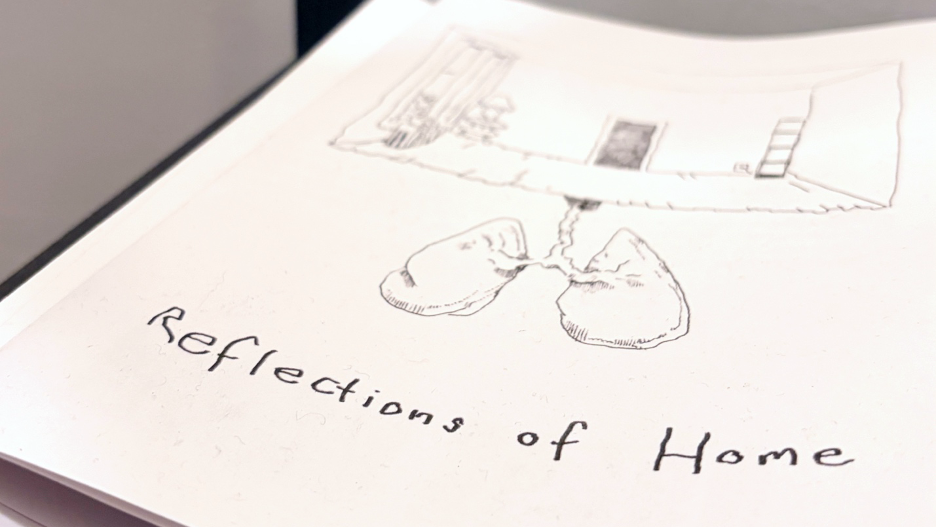
On the second floor of a prewar building on a non-assuming block of Flushing, Queens, one might stumble upon a vibrant community of young artists making work and creating community. There is no signage announcing arrival, no threshold that signals entry into the capital “A” capital “W” Art World. Instead, there is a buzzer, a staircase, and a living room temporarily transformed. This is where Reflections of Home, the inaugural exhibition at The Living Space Gallery, takes place — as an encounter and as a statement of refusal.
Artist-run spaces have long functioned as pressure points within an ever-changing city. They emerge where institutions fail, where markets exclude, and where artists refuse to wait for permission. In a city defined by constant movement and precarity, these spaces often appear briefly, sustained by collective effort rather than infrastructure. What distinguishes the Living Space is not simply that it exists, but how deliberately it situates itself within this lineage. Quinn Hoerner and Drew Shechtman did not simply decide to show work. They committed to building the conditions for a community that so often evaporates immediately after leaving a degree program. What unfolds in this apartment art space is intentional — the result of sustained labor and care oriented toward something larger than individual visibility.
The Living Space operates without the distancing mechanisms that typically organize exhibition spaces. Art is not separated from the conditions of its making, nor from the social relations that sustain it. The apartment setting collapses the distance between production and presentation, folding artistic practice into the rhythms of daily life. Art is encountered through conversation, movement, and shared presence rather than institutional choreography.
Artists have repeatedly taken cultural production into their own hands when no sanctioned space existed for them. This has taken many forms. In Los Angeles during the 1970s, artists such as Senga Nengudi and David Hammons staged actions and performances in public and overlooked spaces — including under highways and in the street — situating art within everyday movement rather than institutional enclosure. Gordon Matta-Clark’s artist-run site 112 Greene Street created a setting where unfinished work, collective presence, and experimentation could unfold outside institutional polish. Claes Oldenburg’s The Store collapsed studio, exhibition, and everyday exchange into a single storefront, bypassing galleries entirely. Queer ballroom culture built elaborate systems of performance, kinship, and recognition without institutional validation, while informal gatherings at the Christopher Street Pier transformed abandoned urban space into a site of culture, survival, and authorship for Black and Latinx queer and trans communities. These examples are not exhaustive. They are fragments of a longer history in which marginalized artists and communities created space through use, presence, and care rather than permission.
The Living Space belongs to this continuum — not as reenactment, but as a contemporary response to similar pressures. It does not claim permanence or authority. It claims responsiveness: an ongoing commitment to show up, to host, and to make room. This orientation reframes access. Visitors are not consumers passing through a formalized cultural site. They are guests, neighbors, and participants. The space resists the fiction that art must be isolated from life in order to acquire value. Instead, value emerges through shared time and mutual attention.
The Living Space functions through refusal, though not as negation. Refusal of permanence. Refusal of profit as the primary measure of success. Refusal of scale as a requirement for legitimacy. Exhibitions occur bi-monthly and last one night only. What remains is the memory of having been present and the relationships formed through that presence. This structure resists the extractive logic of the art world, where visibility is hoarded, presence is rewarded through networking rather than care, and artistic labor is routinely deferred or subsumed.
Refusal here is not retreat. It is a construction. Like many artist-run initiatives before it, the Living Space extends practice beyond the studio and into public life, not as a gesture but as an organizing principle. Its mission is explicit — to create a space where art can exist on its own terms, foregrounding accessibility, experimentation, and community rather than prestige or profit. What emerges is an alternative that is lived and maintained rather than announced.
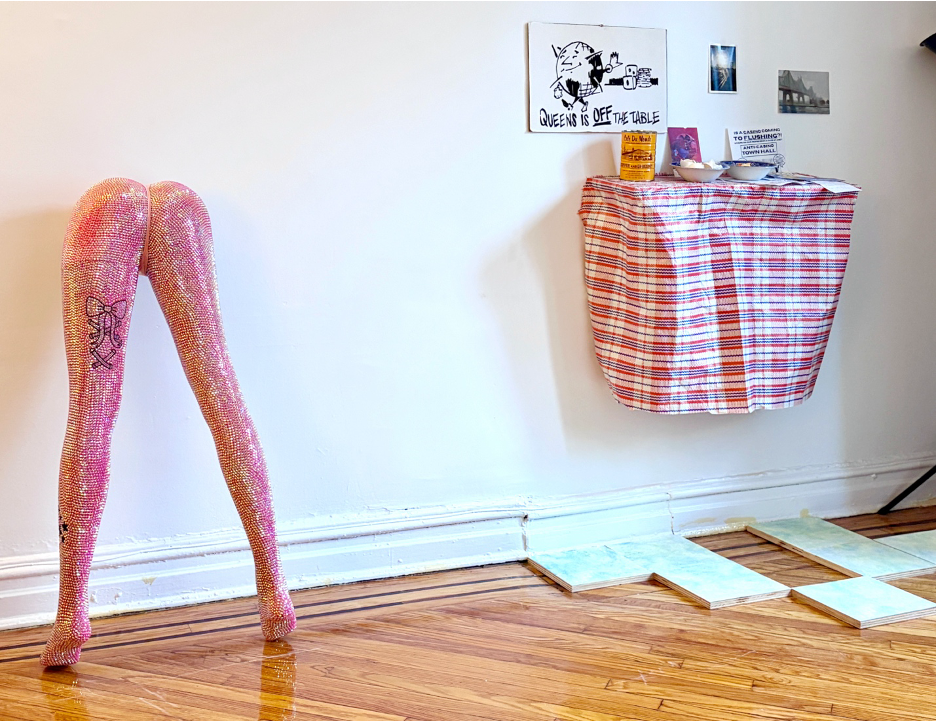
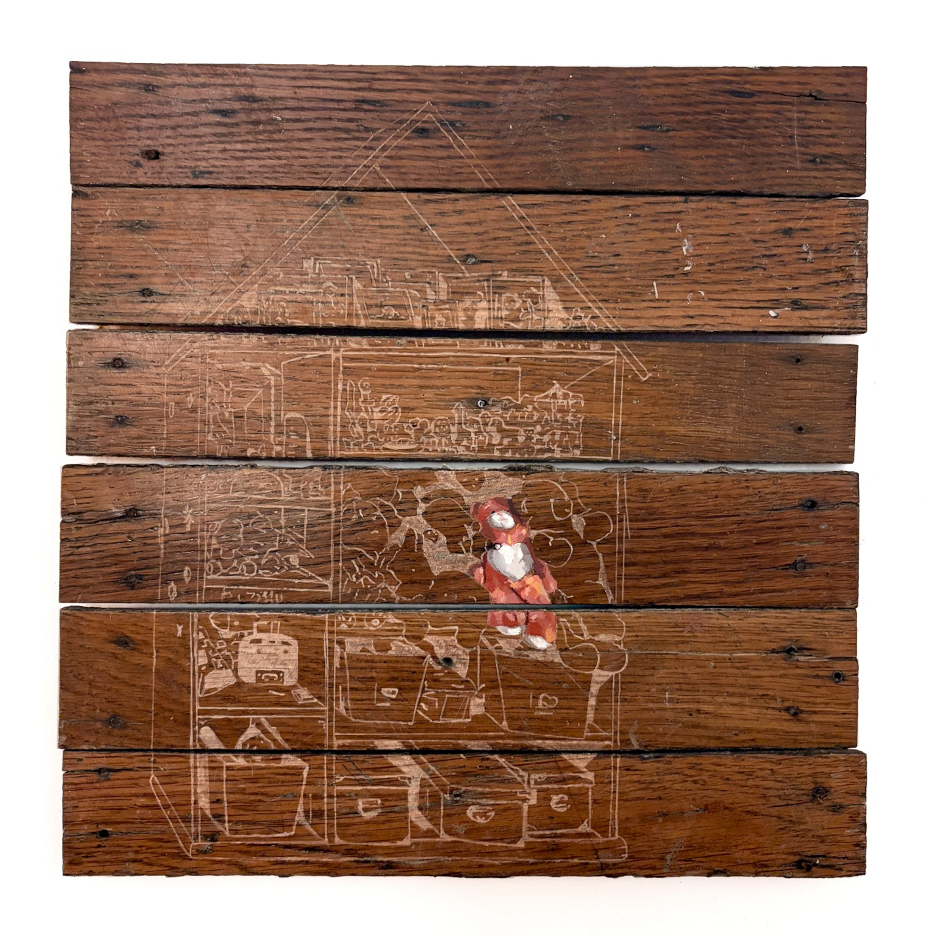
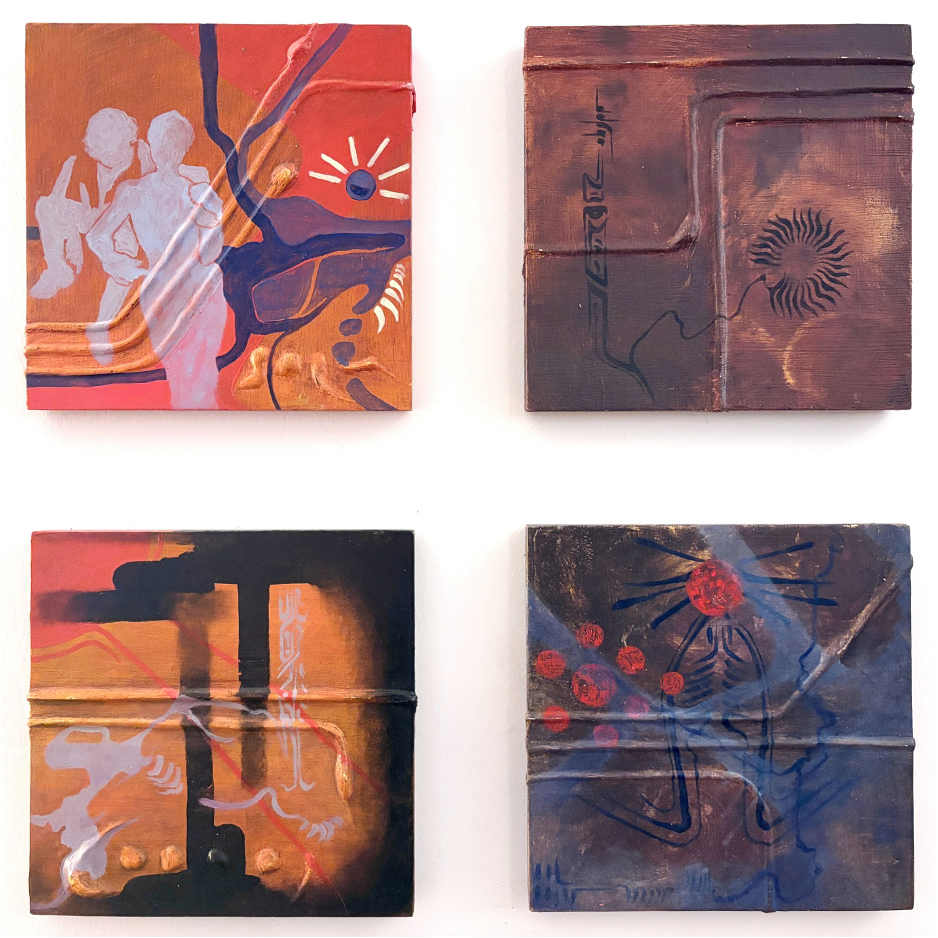
Reflections of Home brings together five artists — Quinn Hoerner, Priscilla Villacres, Kitty Wang, Car Lara, and Iliana Citlali Lara — all working in Queens and rooted in the city that shaped them. Home emerges as something continually formed and fractured in a city marked by displacement, gentrification, and flux. The exhibition does not propose a singular definition. Instead, it holds multiple, often contradictory experiences in proximity.
Across mixed media, sculpture, painting, and drawing, the works do not attempt to explain home as an abstract concept. They inhabit it as a lived condition. Memory, place, and belonging surface through material choices and embodied gestures rather than through didactic framing. This is not nostalgia. It is an articulation of what it means to remain — to continue living and working in the city even as its conditions shift.
Rather than treating Queens as a backdrop or aesthetic resource, the exhibition foregrounds immediacy. Place is experienced through daily labor and ongoing presence. This emphasis mirrors the Living Space itself, which privileges encounter over representation and participation over distance.
The exhibition exists through bodies. Artists, visitors, and neighbors gather in close quarters, speaking with one another and experiencing space collectively. The crowd forms a temporary public rather than a passive audience. This collective presence is integral to the space’s meaning. The energy required to produce these nights mirrors the energy of the studio — sustained, precarious, and often unseen.
This dynamic is especially resonant in the context of post-degree life, when institutional scaffolding falls away, and community must be rebuilt from scratch. The Living Space responds directly to this condition. It acknowledges that making work in isolation is insufficient. Artists require spaces to share, to test ideas, and to be seen without mediation by markets or institutions that frequently reproduce exclusion.
Community here is not an ideal. It is a practice. It is built through labor, proximity, and risk. Opening one’s home reshapes daily life, setting in motion a process that requires trust, vulnerability, and ongoing commitment. The Living Space enacts community through care.
Artist-run spaces have always carried this function — sites of survival, experimentation, and mutual support. What distinguishes the Living Space is its clarity. It builds upon this lineage while adapting it to contemporary conditions of austerity and enclosure. Success is redefined. It is not measured through accumulation or recognition, but through continuity of care and shared effort.
The Living Space will continue to host one-night exhibitions every other month. Each event exists briefly, then disappears. What remains is the knowledge that alternatives can be practiced in real time. These artists are not waiting for permission. They are building what they need, together.
FOR MORE INFO, visit The Living Space’s Instagram or email thelivingspace.nyc@gmail.com.
Contextual Note: This essay is informed by critical writing on refusal, care, attention, and non-market cultural production. Key influences include Experiments in Imagining Otherwise by Lola Olufemi, which frames alternatives as lived practices rather than deferred futures, and Dark Matter: Art and Politics in the Age of Enterprise Culture by Gregory Sholette, which foregrounds invisible artistic labor and artist-run infrastructures operating outside market recognition. How to Do Nothing by Jenny Odell informs the essay’s attention to presence, refusal of productivity, and non-extractive modes of being together. Additional grounding comes from The Problem with Work by Kathi Weeks and Wages Against Artwork by Leigh Claire La Berge, both of which critically examine labor, refusal, and the entanglement of art, value, and institutional structures.
founders: @drfartens (and artist); @blu.e.drew
artists: @car1ara; @yuckabyss; @priscillalilyv; @kitkitschh
About the writer: john ros (they, them) is a queer, non-binary, multiform conceptual installation artist working between Eastern Connecticut, New York City, and Boston, Massachusetts. They are currently a Ph.D. student at Tufts University and hold an MFA from Brooklyn College, CUNY, and a BFA from SUNY Binghamton. John’s mixed media conceptual installations focus on ritual as performance, space/place, light, and time. Their work has been exhibited internationally and is held in collections worldwide. They are the director of studioELL (insert link: https://studioell.org) , a space for radical education in studio art practice, which they founded in London, England, in 2015. john also teaches at the School of the Museum of Fine Arts at Tufts University in Boston, MA, and Naugatuck Valley Community College in Waterbury, CT.
More Articles:
https://artspiel.org/emergent-strategies-in-defense-of-weeds-at-stand4-gallery