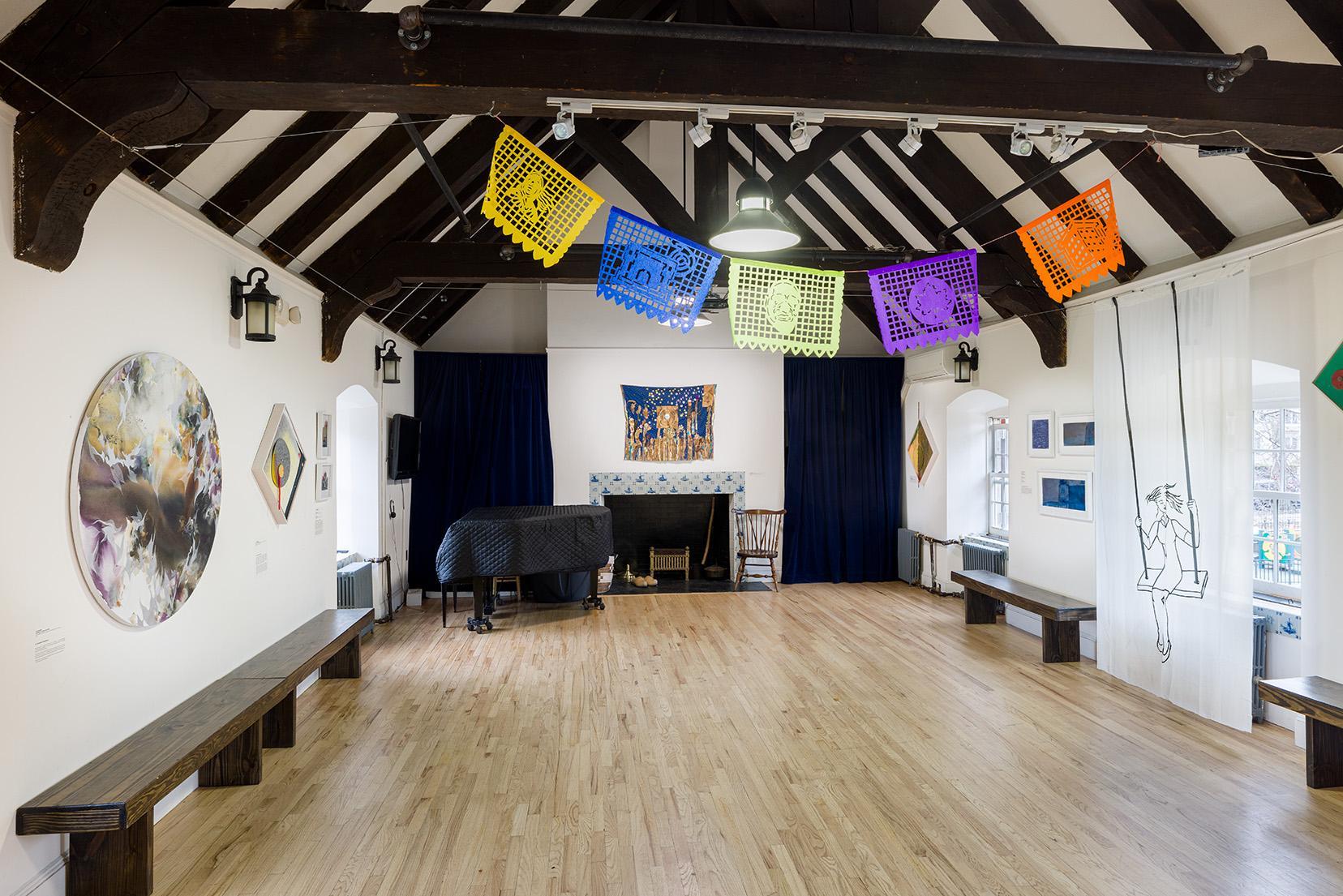
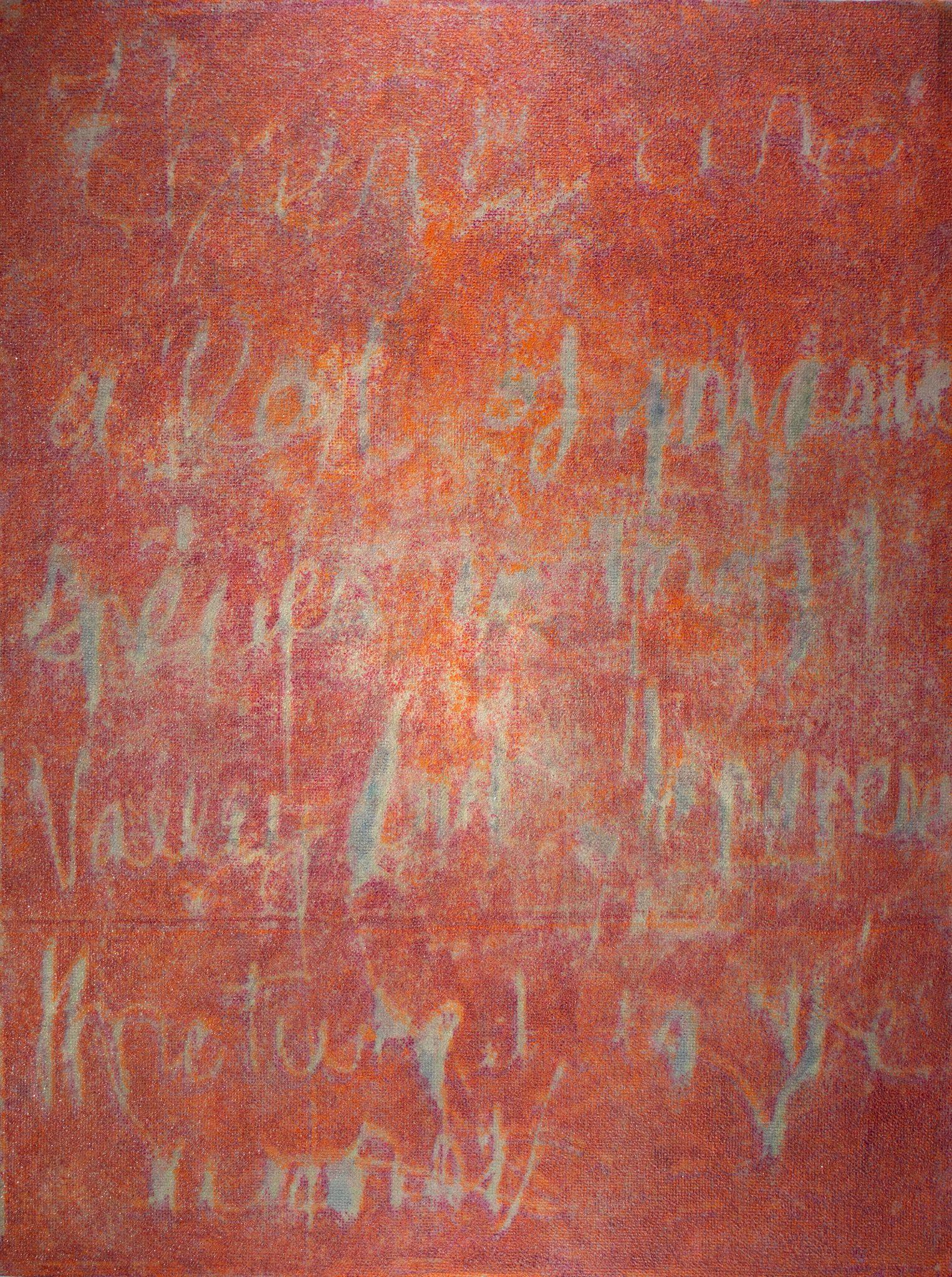
Nancy Bowen with “Third Eye” and “Throat” from Chakra Series, 2009, mixed media on paper, photo by Lindsay Walt
What links Nancy Bowen’s work at Westchester Community College Art Gallery—from abstract to narrative work—is the presence of the female body in some form. “I will always be compelled to create work from a feminist point of view, work that needles or asks questions, and given our current political and social climate, that seems even more necessary than ever,” Bowen says. The show runs through April 12th, 2023.
David Dempewolf, imago 02 (bird’s eye self portrait), 2013 aqueous media and wax pencil on paper, 10” X 14”, courtesy of artist
Most artists’ studios give us a glimpse into their thought and work process but wandering through David Dempewolf’s studio gives more than a glimpse. It is an experience of entering a wonderous world— a hidden niche reveals a station for experimental animation, a corner serves as a station for wood printmaking, a quaint staircase to a small attic leads to imaginative series of drawings, and a “peephole” in a wall further guides our gaze below, to Marginal Utility, the non-for-profit gallery space he runs with his partner and spouse Yuka Yokoyam. It feels like entering a Borgeisan world where the artist’s thoughts and the endless possibilities of “cataloging” entangle and materialize into a new entity in a tangible space.
Nancy Cohen, Segment of handmade paper loop that circles the gallery. Wire, thread and handmade paper, 80” x 140” x 46,” 2022. Photo credit: Maddie Orton
In the fall of 2019, Meagan Woods, an interdisciplinary artist working in dance, theatre and costume design, attended an arts/science event at Simon Fraser University in Vancouver, Canada where she was an MFA student. She was both alarmed and inspired by what she learned about the critical condition of coral reefs around the world caused by climate change. In response, she assembled a team consisting of four colleagues in the MFA Interdisciplinary Arts program and a New-Jersey based visual artist to create what eventually became an innovative, experimental opera/installation called Once She Dries. Besides Woods, the collaborative includes pianist and composer, Casper Leerink; filmmaker, photographer and installation artist, Xinyue Liu; violinist and composer, Kourosh Ghamsari-Esfahani; musician and actress, Amanda Sum; and sculptor and installation artist, Nancy Cohen.
A central theme in my Crazy River project has been highlighting the emotional toll of the climate crisis by putting under a microscope, so to speak, my own feelings about not only the impacts of the crisis but the knowledge that humans’ actions are the cause. This series of three on-line essays, thought experiments if you like, expands that project to change the POV to non-human actors that are inextricably bound with the habitat in the Western Catskills: the black-legged or deer tick (Ixodes scapularis), the white-tail deer (Odocoileus virginianus), and Japanese knotweed (Reynoutria japonica). All three have seen their habitat change dramatically through climate change and human interventions. Using my imagination and research, I try to enter the umwelt of all three species, an impossible task, as Thomas Nagel pointed out in “What Is It LIke to Be a Bat,” for which artistic license may give us the best chance to accomplish. My intentions in doing so fall along three axes: theoretical, aesthetic, and spiritual, dimensions all essential to my own art practice. Part III looks at the umwelt–a term normally applied only to animals whose use in this instance I will explain later–of Japanese knotweed from the perspective of the Vajrayana, or Tantric Buddhism.
Paintings are the products of imagination whose language is feeling and form. My paintings describe an interior theatre where the relationship of energy to limitation unfolds in a drama that is primarily optical. The work references the natural world filtered through the lens of the marvelous and invites the viewers’ participation and interpretation…. a task ideally suited to painting.
Hovey Brock: Frost Valley, 2019, 36” x 48”, acrylic on panel
A central theme in my Crazy River project has been highlighting the emotional toll of the climate crisis by putting under a microscope, so to speak, my own feelings about not only the impacts of the crisis but the knowledge that humans’ actions are the cause. This series of three on-line essays, thought experiments if you like, expands that project to change the POV to non-human actors that are inextricably bound with the habitat in the Western Catskills: the black-legged or deer tick (Ixodes scapularis), the white-tail deer (Odocoileus virginianus), and Japanese knotweed (Reynoutria japonica). All three have seen their habitat change dramatically through climate change and human interventions. Using my imagination and research, I try to enter the umwelt of all three species, an impossible task, as Thomas Nagel pointed out in “What Is It LIke to Be a Bat,” for which artistic license may give us the best chance to accomplish. My intentions in doing so fall along three axes: theoretical, aesthetic, and spiritual, dimensions all essential to my own art practice. What follows is a look at the umwelt of white-tailed deer from the perspective of aesthetics.
Hovey Brock: Blackleg Tick, 2021, 24” x 36”, acrylic on panel
A central theme in my Crazy River project has been highlighting the emotional toll of the climate crisis by putting under a microscope, so to speak, my own feelings about not only the impacts of the crisis but the knowledge that humans’ actions are the cause. This series of three on-line essays, thought experiments if you like, expands that project to change the POV to non-human actors that are inextricably bound with the habitat in the Western Catskills: the black-legged or deer tick (Ixodes scapularis), the white-tail deer (Odocoileus virginianus), and Japanese knotweed (Reynoutria japonica). All three have seen their habitat change dramatically through climate change and human interventions. Using my imagination and research, I try to enter the umwelt of all three species, an impossible task, as Thomas Nagel pointed out in “What Is It LIke to Be a Bat,” for which artistic license may give us the best chance to accomplish. My intentions in doing so fall along three axes: theoretical, aesthetic, and spiritual, dimensions all essential to my own art practice. What follows is a look at the umwelt of black-legged ticks from the perspective of theory.
Jody MacDonald, Everywhere All Over. All Over. Everywhere. (detail), mixed media, 168″ x 180″ x 96″, 2022.
Jody MacDonald dissects in detail the concept of “identity” through a cast of small-scale 2-D and textile-based 3-D surrogates. She uses repurposed materials to create figures and detailed, miniature accessories (wigs, clothing, shoes furniture) set inside elaborate, mixed media environments with clues which shed light on the complex, often conflicting narratives.
A Conversation Between Christine Sullivan and Marianne Gagnier
Christine Sullivan, The Place Between, 44 x 32” oil/linen
This conversational exchange between artists Christine Sullivan and Marianne Gagnier was catalyzed by artist and writer Paul D’Agostino. He encouraged them to engage in dialogue with one another upon noting that they had both produced new bodies of work, right around the same time, featuring bird imagery. Taking this as impetus for a fertile discussion, Marianne and Christine decided to interview one another regarding themes of journeys and migration, and they discovered a number of surprising points of connection in their lives.
Dancers Unlimited members at Waikalua fishpond in Hawai’i. Photo credit: Jordan Medeiros
Brooklyn Arts Council announced in March 2022 an allocation of over $1.3 million to 238 Brooklyn-based artists and cultural organizations. This year marks the highest number of grantees and awardees as well as the largest amount of funding BAC has ever distributed. Art Spiel in collaboration with Brooklyn Arts Council features some artists who received a Brooklyn Arts Fund, Local Arts Support, and/or Creative Equations Fund grant in 2022.