In the studio in Newark, NJ, 2018. Photo courtesy of the artist.
New Jersey and Manilla based artist Katrina Bello draws on memories of her childhood experiences in the Philippines. Ranging from small to large scales. her drawings depict geological layers as vast fields of textures and colors – alluring us to sense the awe in vastness while also inviting us to get close and sense the fragility and tenderness in each detail.
Artist in her Studio. Photo by Ryan Bonilla 2019 . Photo by Ryan Bonilla 2019
Maria de Los Angeles says she feels very blessed to be included in the Domestic Brutes exhibition at the Pelham Art Center. A DACA recipient, she grew up undocumented and currently she is working on getting her citizenship, looking forward to contributing by voting for the first time. “Since I arrived to this country 20 years ago, I have looked forward to Voting. I love this county and consider it my home and can’t wait to do my part by helping elect new people. I truly believe we can build a better future together,” she says.
Melissa Stern is an artist, working in mixed materials and across genres. She is interested in ideas that are simultaneously funny and dark- that is, “work that might make you smile or laugh, but with a wee bit of discomfort,” as she puts it. Much of her work of recent years focuses on home and childhood and the ways in which our childhoods and our memories haunt our lives. She works in clay, found objects, wood, metal collage and various drawing materials. Her goal is that the materials she uses are at the service of the ideas. On a different note she says, “I am an only child, raised by older parents who were first generation Americans. My mother desperately wanted to be ‘American’. My father was very connected to his European heritage. This push and pull; between belonging and being an outsider has profoundly influenced my life as an artist.” Melissa Stern is participating in Domestic Brutes at Pelham Art Center.
Jacqueline Shatz‘s ceramic based wall sculptures depict biomorphic forms, mostly referring to animals and humans as a single entity. An abstracted silhouette of an agile swimmer, a whimsical hybrid of horse and baby snake, a queen’s bent head fully covered by flowing hair spilling downward – each evokes a mystery associated with ancient civilizations, archetypes, and mythologies or what the artist describes as “states of being and permeable nature of time.” Jacqueline Shatz shares with Art Spiel some thoughts on her work and work process.
At the Elizabeth Murray Artist Residency by Collar Works, Granville, NY, July 2019, Photo by Monica Hamilton
Will Hutnick is an artist, curator, co-director of Ortega Y Gasset Projects in Brooklyn from 2015 to 2020 and Director of Artistic Programming at the Wassaic Project upstate NY. In his paintings Will Hutnick is using rollers, and includes other mono-printing-like methods to create repetitive passages which form playful and unexpected relationships between shapes and colors. He shares with Art Spiel some of his work process, reflections on the ways his paintings have developed, and some of his other art related practices.
Noa Charuvi’s paintings convey a distinct sense of place where narratives of the present interrupt those of the past with urgency, sometimes even violence . Yet, her places encapsulate past and present not only as a rupture but also as an ongoing flow of coinciding contradictory forces – ruin and construction, anarchy and order. No matter if the painting depicts an interior of a room or an exterior of a construction site, it frequently portrays a place that is devoid of human figures but charged with the aftermath of human actions. Even if human figures are present, they are typically placed in context of their larger environment, players in a powerful and mysterious systemic forces of history, city, society. Noa Charuvi shares with Art Spiel some insights on her ideas, work, and process.
Padma Rajendran, Along the way, 2019, Dye on silk with stitching, dimensions varied, photo courtesy of the artist
Malaysian born and New York based artistPadma Rajendran works in diverse media yet currently views paper and fabric as her primary materials. She highlights the portable nature of paper and fabric, along with their significance as “keepers of culture, comfort, and call upon the function of the decorative”. Padma Rajendran shares here some insight on her work, what brought her there and where she is heading from here.
One Tree, Two Mouthy Ghosts, 2019, Oil on canvas, 30 x 40 inches, photo courtesy Max Yawney
Meg Atkinson‘s paintings resemble puzzles open to multiple solutions. Her imagery is embedded with associative literary and visual layers, as clues to an open-ended riddle. Meg Atkinson shares with Art Spiel what brought her to art, as well as the way she has developed her approach to mark-making, space, gird, and color.
Gabriel J. Shuldiner dislikes categorization of his work to the point that he invents new “isms” to describe its allusive hybridity – its DNA can be traced to abstraction with elements of minimalism, expressionism, and Arte Povera. While Shuldiner’s use of material is extensive , his use of color is restricted to mostly black, with tinges of other colors at times. Gabriel J. Shuldiner shares with Art Spiel some of his thought and work processes.
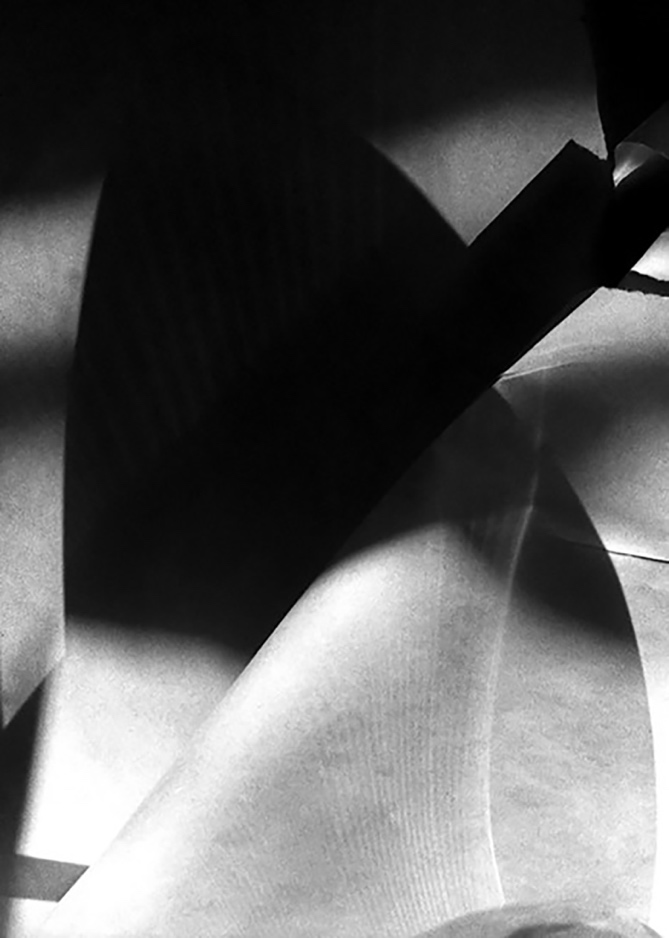
Soft Black Petal, silver gelatin print, 20×24”, 1985
Paulette Myers-Rich ‘s photography-based art books and prints reference abstracted landscapes where industry and nature intersect. Paulette Myers-Rich has consistently focused her gaze on the very moment of transformation in both interior and exterior spaces, when a place, nature, history, altogether shift. The artist shares with Art Spiel how she has developed her practice, her notions on book making, and how she sees her role as an artist today.