Notice: Function WP_Object_Cache::add was called incorrectly. Cache key must not be an empty string. Please see Debugging in WordPress for more information. (This message was added in version 6.1.0.) in /www/artspiel_344/public/wp-includes/functions.php on line 6131
Daze and Crash for Welling Court Mural Project. Photo by Joe Iurato
A few weeks back, an intergenerational group of five iconic NYC graffiti and street artists descended on Welling Court Mural Project (WCMP) in Astoria, Queens. The latest batch of mid-sized murals to grace this otherwise unassuming treasure trove of paint at the intersection of Main Avenue, 30th Avenue, and Welling Court includes Chris “Daze” Ellis, John “CRASH” Matos, JM Rizzi, Queen Andrea, and Joe Iurato, a world-class lineup whose collective come-up eras span the 1970s into the aughts.
Guzman, Kurt Cobain In Bed, Los Angeles, 1992, Archival Ink on Mulberry Paper, 32 x 22 inches
Portraits are collaborations between the sitter and the artist. Sometimes the artist can be overwhelming or patronizing but in most cases the sitter’s vision of how they would like to be seen now and in perpetuity wins out. This is particularly seen in cases of well known personalities. Prime examples are the portraits of Andy Warhol exposing his scars after being shot to both Alice Neel and Richard Avedon. In these vastly different images Warhol clearly wanted the world to know what had been perpetrated against him and how his suffering lingered. When the portraits are images of celebrities, particularly those in the last few decades, the public has a strange sense of possession, teetering on full-blown obsession. The success of the portrait hinges on several factors from the artist including generosity, intelligence, empathy, skill, and creative facility. Fortunately this is what is on exhibition at LABspace in Hillsdale NY, Kurt and Courtney, by collaborative photography duo Guzman. Guzman is made up of Constance Hansen and Russell Peacock. In their 30+ years of photography they have solidified a reputation across all genres from conceptual and documentary work to bringing cool, enlightened, humanizing aesthetics to the commercial worlds of fashion, advertising, and celebrity portraits. As summed up in a recent discussion about their work, Constance Hansen said the intent is not to make a mean photo, but a photo that embraces the person.
At a certain point in one’s life, they stop making new marks or registering new memories. All that remains is a fluid, ever-changing assemblage of the fragments from the past. I would call it no stagnation: it is rather a moderate manner of growing at a different pace.
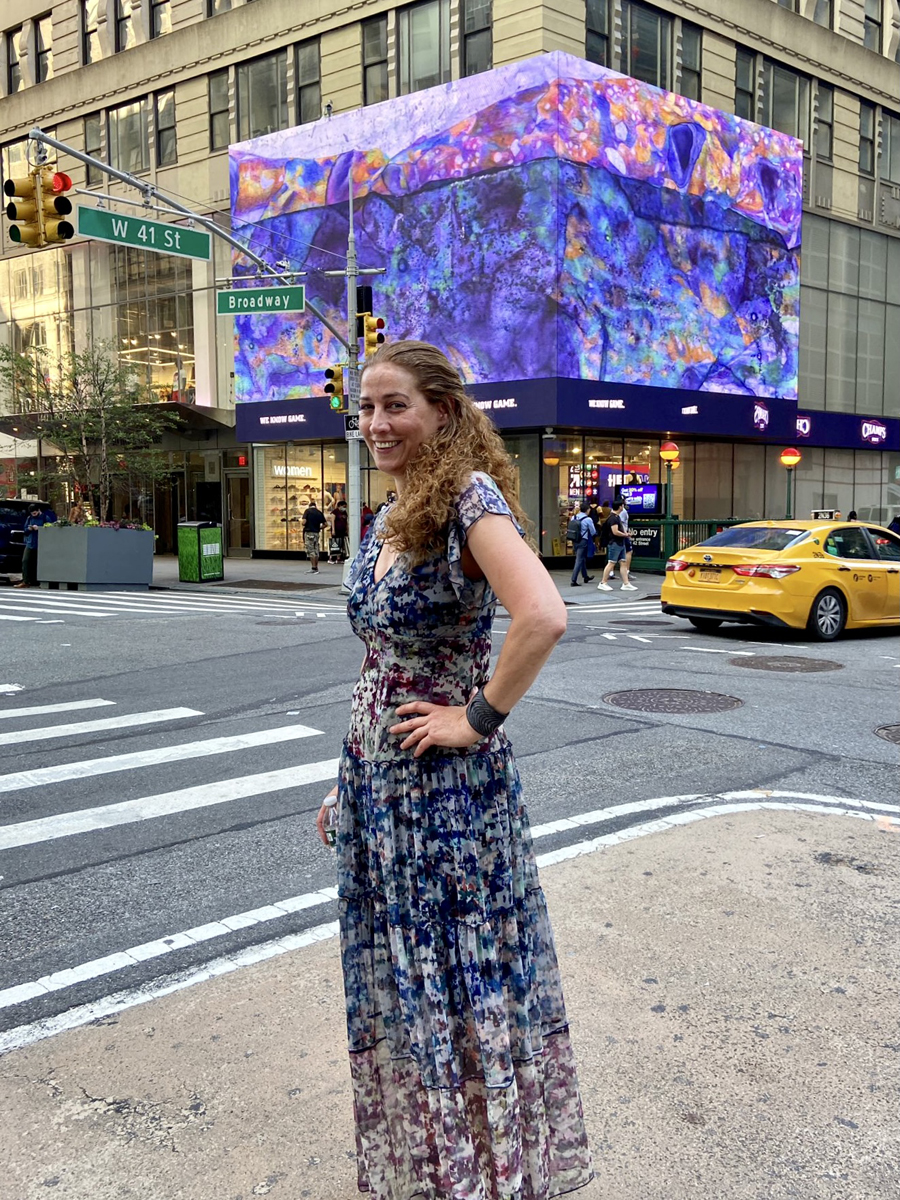
The artist in front of the billboards featuring her work, I Wish I Had a River, The Underground Lobby Garden.Photo credit:ZAZ10TS
Keren Anavy’s site-specific multi-media installation I Wish I Had a River creates a sense of a painted garden made of paintings, drawings, laser cutouts, sculptures, and video within the confines of the lobby of 10 Times Square. The artist draws on the history, architecture, and ecology associated with her installation site–the center of the bustling garment district; and Art Deco architecture of the building. Moreover, merely 40 years before its completion, New York’s biggest reservoir and supplier of all of Manhattan’s drinking water in the 19th century was decommissioned and torn down one avenue to the East. This relationship between nature, particularly water, functioning as a cultural agent and an important element of consumerism is of particular importance for Anavy, who grew up in a desert region of conflict, where the water resource was scarce. The show is curated by Lauren Powell and runs at ZAZ10TS through August 31, 2021.
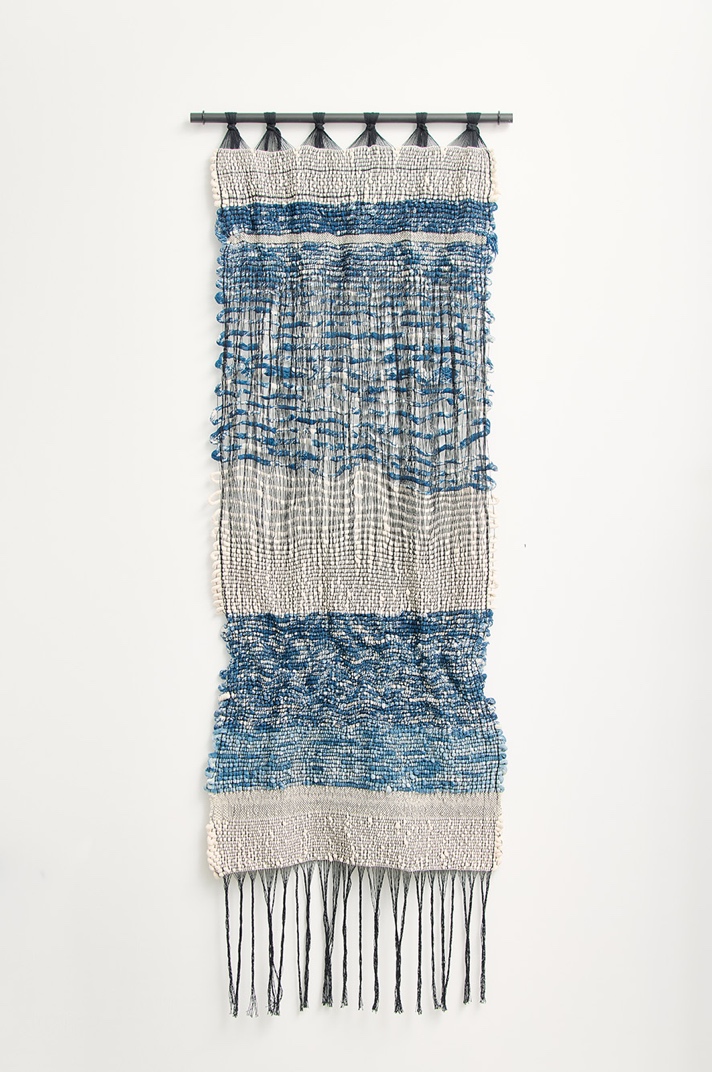
Agua/Cielo, 2021 Cotton, wool, indigo, wire and steel. Photo by Brian Schutza courtesy of the artist.
“…I try to follow the threads where they lead in order to track them and find their tangles and patterns crucial for staying with the trouble in real and particular places in time.”
– Donna J. Haraway, Staying with the Trouble: Making Kin in the Chthulucene.
The undulating asymmetry of Stephanie Eche’s weavings in her solo exhibition Handmade Landscapes: Ocean Meets Sky that ran through July 26th, 2021 at High Line Nine, leaves space for you to interpret. The first work that your eyes encounter, Agua/Cielo, mirrors staring out at an ocean horizon that becomes the air above, a direct embodiment of the show’s title. The loosely woven piece speaks to the cyclical nature of water; its evaporation and transformation into rain that returns it to earth.
Installation view of Jorge Otero-Pailos: Distributed Monuments. Courtesy of Sapar Contemporary
One could say that the primary medium of Jorge Otero-Pailos’s work is liquid latex, but perhaps it would be more accurate to say that his medium is time – or rather, the passage of time made visible. In Distributed Monuments at Sapar Contemporary, Otero-Pailos presents a series of latex casts mounted on canvas from the old U.S. Mint in San Francisco, California and from the pool at Lyndhurst Mansion in Tarrytown, New York. Two monumental sites on opposite coasts come together – one representing the literal creation of wealth, and the other an accumulation of it by an elite family. These latex casts have extracted dust from the sites, which are both in states of preserved ruin, but can be visited by the public.
Installation view featuring Mitch Vowles, Earnie, 2021, Fruit Machine, Photographs, Water, 175 x 70 x 65cm courtesy of Grove Collective, photographed by Ollo Weguelian
Dibnah in Lights is hard to miss. The name of that legendary Yorkshire steeplejack flashing in red, white, and blue bulbs against the green felt backdrop of a repurposed snooker table is the first piece that greets you as you walk through Grove Collective’s doors. This piece by Mitch Vowles, a sculptor who works with found objects to draw out their cultural and personal contexts, nestles easily amongst Connor Murgatroyd’s pastel-hued still life paintings of anthuriums, signet rings, Sinatra albums and a scaffolders A-Z, and film photographer Alfie White’s hand-printed images of boys at Brixton bus stops, on Tottenham blocks, and playing in Burgess Park.
Test Kitchen, Carolyn Case’s show at Reynolds Gallery in Richmond, Virginia, consisted of 4 oil paintings on panel along with 8 pastel drawings. Hefty brush strokes fill the surface area of the oil paintings. The painterly process involves a buildup of incremental adjustments, the layers of paint applied one by one until the shapes solidify into a kaleidoscopic arrangement; one nudge and the elements will shift accordingly, morphing the image into an entirely new pattern. Each of the paintings gives the impression of a specific time of day, indicated by the character of light and color playing across the space. Monet’s Water Lilies come to mind. But in place of Monet’s serene refuge, Case’s light lingers over a sink full of dirty dishes.
Stronger than Dirt: Melissa Stern at the Lockwood Gallery, installation shot
Walking into The Lockwood Gallery in Kingston NY one is instantly transported into another Universe. One populated by people and things who clearly are living in a world parallel to ours, but profoundly different. Smiling figures stand tall, grinning at the world, while all the time missing a limb or two. Or having their feet nailed to the ground. Images from vintage magazines merge seamlessly with Melissa Stern’s drawings. Her world is populated with folks who exhibit a stubborn resilience in the face of cosmic obstacles. Hence the exhibition’s title – Stronger Than Dirt.
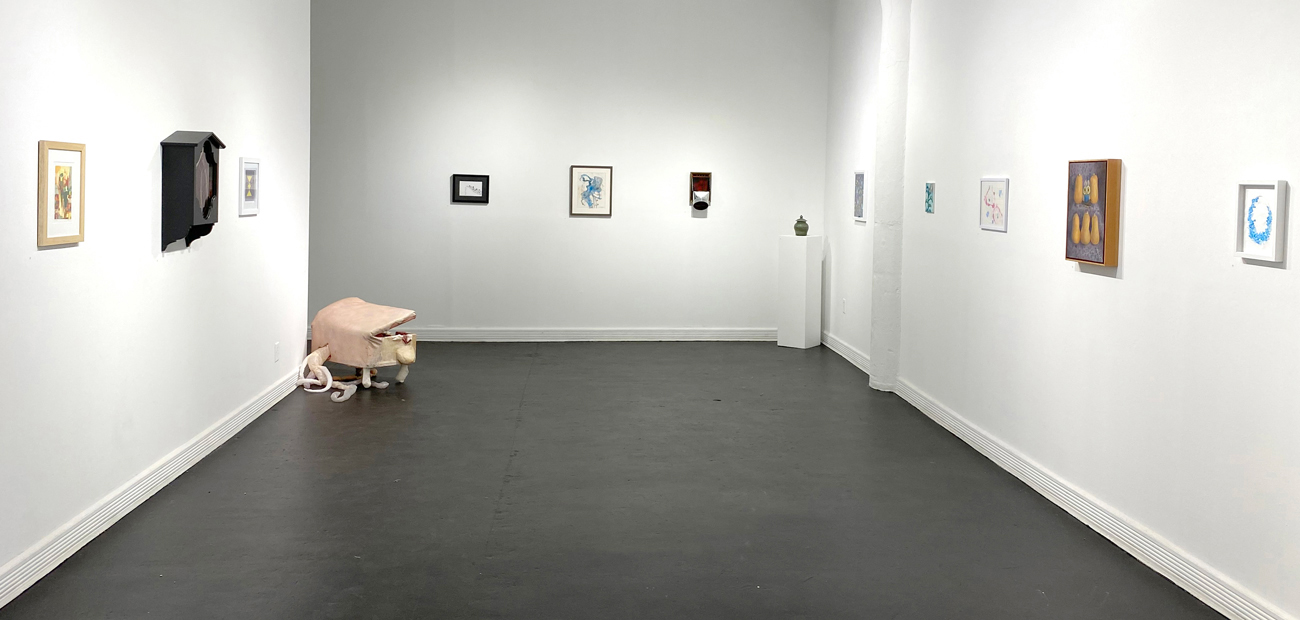
Partial view of gallery installation, photo courtesy Jon Bunge
Twenty Twenty Twenty One is a group exhibit and corresponding artist book created by 18 artists. During the darkest days of the past year, the fellowship this group of artists built became a beacon of hope. The artists initially congregated in early April of 2020, during the height of the Covid-19 pandemic, via weekly Zoom meetings launched by artist Mike Sorgatz, that continued through the year and up to the present. Inspired by their camaraderie, in late summer of 2020 they began casually discussing making a book to share artwork loosely relating to themes of community and connection. This book expanded into a corresponding exhibit, with Janice McDonnell generously taking the initiative in early December of 2020 to curate the exhibition at Sweet Lorraine Gallery.