Notice: Function WP_Object_Cache::add was called incorrectly. Cache key must not be an empty string. Please see Debugging in WordPress for more information. (This message was added in version 6.1.0.) in /www/artspiel_344/public/wp-includes/functions.php on line 6131
Installation view of Pauline Decarmo: Exit at LABspace, 2022, photo courtesy LABspace
Some artists paint stunning abstractions, some artists deftly execute exquisite realistic images, while others ingeniously develop astute conceptual work, but the truly magical art is work that can intelligently create the aura of time, space, and experience. Fortunately Pauline Decarmo, by using any means necessary, does exactly that in her exhibition, Exit, on view at LABspace in Hillsdale NY through May 29.
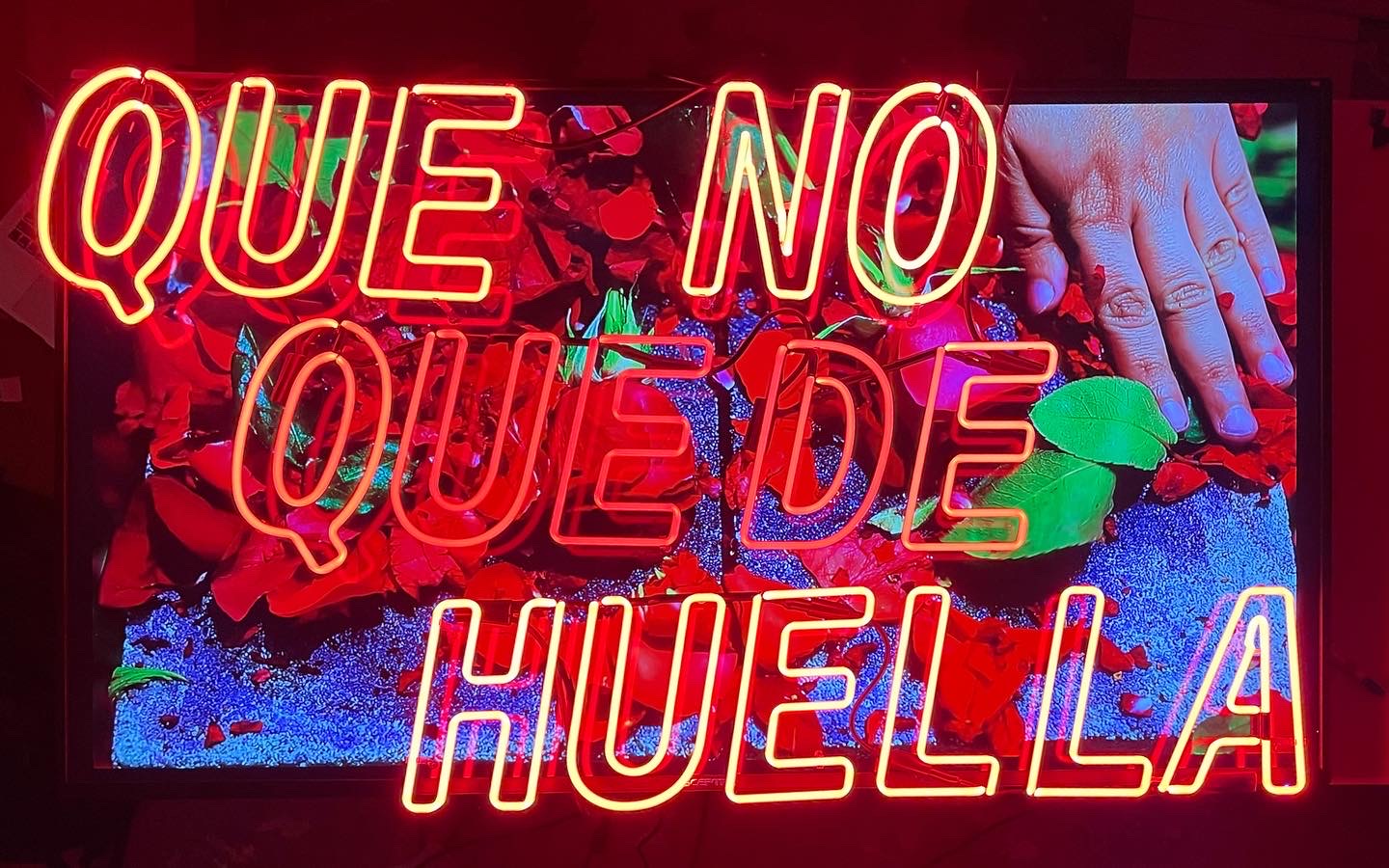
Jesus Benavente, Quede Huella (Let There Be No Trace), 2022, Neon video, 49.5 x 29 x 8 inches. Photo courtesy the artist.
At 291 Grand Street, a bright red glow radiates from Home Gallery, a storefront window exhibition space in the Lower East Side. The light comes from large, fluorescent neon letters that spell out “Que no Quede Huella,” which are layered over a flat screen TV playing a rotating series of videos. The installation is the latest iteration of multimedia artist Jesus Benavente’s neon video sculptures, displayed in the exhibition Que no Quede Huella (Let There Be No Trace), curated by Elisa Gutiérrez Eriksen.
To kick off the Dumbo Open Studios Weekend in late April, Platform Project Space opened MOD, a five person show commanding strong appeal, curated by Sharon Butler. As the title and press release indicate, modularity, modernism and mods, or modifications in contemporary gaming, are all potentially at play both in the individual works and together as an installation. Each artist’s contribution holds a single wall or area in a small room that’s comfortable, easy, and open. The formal language of color and shape is nuanced to suggest personal and organic qualities and intimate spaces. No mystery here. Instead, curiosity openly hovers in close examinations of the human touch, in the detail and care given to small moments.
Installation view, Cat Del Buono, “Voices,” July 17 – 31, 2020 at Microscope Gallery, New York, NY. Photo by Seze Devres. Courtesy of Microscope Gallery.
The time is passing but the image dwells. 47 men are posing to get their picture taken, completely still. These men in suits and ties are U.S. Attorneys in the year 1933, basking in their moment of power and glory. Above them, an old wall clock’s pendulum keeps moving from one end to the other, its ticking sound loud and clear. The moment is eternalized, and the power remains, even now. 89 years and the image is still relevant: White men are in charge. Artist Cat Del Buono’s video piece Time (2011) is an illusory work in between a video and a still, framed and hung like a photograph that uncannily moves, and it displays a perpetual stalemate.
Installation view of The Agreement: Chromatic Presences, curated by William Corwin at Zürcher Gallery. Photo: Adam Reich. Courtesy of Zürcher Gallery NY/Paris.
I’ll start with a question: does a critic have an obligation to propose a solution to an enigmatic puzzle an exhibition might pose? What has led to this, is reading William Corwin’s catalog essay for The Agreement: Chromatic Presences, in which he ignores recounting the history of sculpture and color—deemed for a very long time to be irreconcilable like fish and cheese. It is now common knowledge, sculpture till the time of the renaissance was largely polychromed, but a neo-classical notion of purity and essentialism came to be imposed upon it to differentiate it qualitatively from painting. As a result, sculpture came to be limited to the colors of its materials—marble, bronze and wood. In the West, this formalism was institutionalized by the Enlightenment’s and was the excepted norm until the mid-20th century, when art’s traditional forms began to morph. Consequently, we must ask if there is a more contemporary issue concerning color and form at the heart of Corwin’s The Agreement: Chromatic Presences, and if so, what might it be?
Far from the palatial white cubes of Chelsea or the intimate townhouse spaces of the Upper East Side is a different type of gallery space – one that serves as a reminder of an earlier moment in the art world, and yet persists into the present – the SoHo loft. In his debut solo exhibition, Sam Spillman has created work that probes at this history in In Case Of Sam Spillman at Ulterior Gallery.
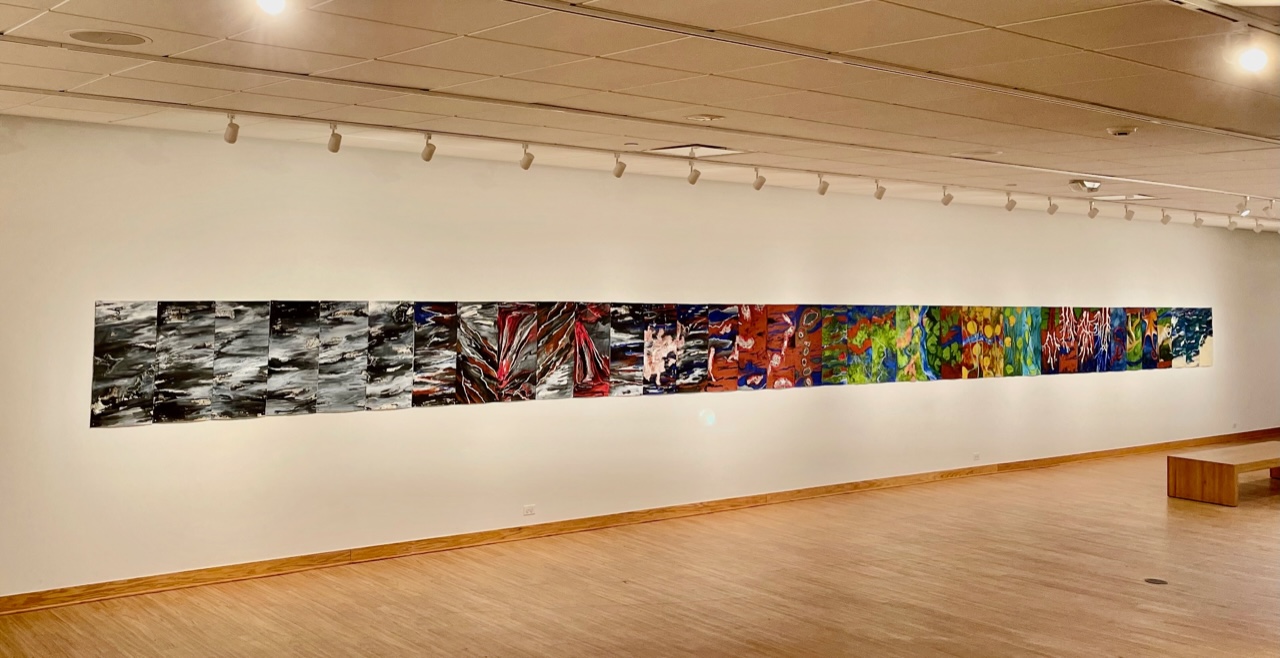
Susan Hoffman Fishman, In the Beginning There Was Only Water, 30 in. x 50 ft., acrylic, oil pigment stick and mixed media on paper, 2021, Installation view at Janice Charach Gallery, West Bloomfield, Michigan
During the height of the COVID-19 pandemic, from 2020 through 2021, eight women artists from the Midwest and the East Coast of the United States came together via Zoom to read and discuss All We Can Save: Truth, Courage and Solutions for the Climate Crisis, edited by Ayana Elizabeth Johnson, Ph.D. and Katharine K. Wilkinson, Ph.D. The book contains essays and poetry by a cadre of diverse women policy wonks, scientists, writers, journalists, lawyers, activists, and others who address the most critical existential issue of our time with the intention of offering different ways to effect change and mend the significant damage that we have caused to the Earth. The artists’ responses to the essays form the exhibition Climate Conversations: All We Can Save. The exhibition runs through June 30th, 2022.
Michelle Weinberg, A Personal Situation, graphite and colored pencil on paper, 20 3/4” x 16″
The two-person exhibition Shuffling Liminal Episodes atProject: ARTspace features drawings by artists Leslie Kerby and Michelle Weinberg, whose works on paper and vellum resemble snapshots of settings, some of specific places, some imagined, capturing an arrested moment from daily life. Both storytellers at heart, the two artists draw objects as protagonists in their visual tales. A desolate bench, a studio table with a lamp, a tiny figure stepping out of a big house —random belongings, furniture, activities of daily life come to the forefront, projecting an inner life while also hinting at human life outside their inanimate existence—always with a lingering whiff of humor. Kerby and Weinberg also share a collage aesthetic which works well to unify their fragmented narratives.
The curatorial team held a fascination with exploring and activating the ceiling, corners, and floors of Equity Gallery via the works that comprise Making Sense Without Consensus. Here are 2 examples of this; on the left, Linda King Ferguson’s work stretching downward to the floor; and on the right, Diogo Pimentão’s work installed to live and extend around the corner of a gallery wall.
Now on view at Equity Gallery in the Lower East Side is a notable group exhibition, cogently titled Making Sense Without Consensus, with works by 14 remarkable artists and 3 astute curators at the helm. The exhibition statement says that these artists explore reality through fragmented connections and geometric materiality, “investigating whether the linearity of time is real or if past and future overlap.” In further absorbing what this exhibition might represent, I also want to offer an illuminating quote from The Radicant (2009), an essay by celebrated curator and critic Nicolas Bourriaud. This thought piece provides context for the development of Making Sense Without Consensus:
“In ordinary language, ‘modernizing’ has come to mean reducing cultural and social reality to Western formats. And today, modernism amounts to a form of complicity with colonialism and Eurocentrism. Let us bet on a modernity which, far from absurdly duplicating that of the last century, would be specific to our epoch and would echo its own problematics: an alter modernity …”
Pritika Chowdhry. What the Body Remembers, 2008. Paper pulp, mason stains. 6 ft. x 3 ft. x 10 ft. installed dimensions. All photographs courtesy of the artist.
On India’s 75th year anniversary, the horrors of the Partition cannot be forgotten. Yet despite the atrocities committed against women, their experiences are often excluded from discussions of Partition’s impact. In What the Body Remembers and Queering Mother India, artist Pritika Chowdhry pushes back against this historical erasure. Revisiting two of Chowdhry’s installations for women’s history month, one is struck by the sensitivity and delicacy of her work alongside the urgency of her message.