Chaos, Video projection mapping and AI animation splash around large and small white cardboard boxes; these display facets of the memories and experiences that are hard to relinquish.
Artist Beverly Peterson has been squirreling away the components of Self-Storage in her studio over several years—collecting, modifying, situating, upending, and repositioning things, paintings, photographs, video, and film. She describes this work as a “deeply personal, emotional, and immersive experience that invites visitors to reflect on their own memories as they explore a dreamlike environment.” It is that, but that’s like describing a particular person as an “ambulating biped with hair.” There’s more.
Installation view, detail, photo courtesy of Etty Yaniv
Sharon Horvath’s paintings in Small Myriad, her current exhibition at Bookstein Projects, create a sense of an alluring universe where dazzling colors, interflowing shapes, and tactile surfaces merge, meander, and as a group form an enigmatic universe unified by a mysterious code. Horvath’s spiraling lines and patterned forms create ebbing and flowing movements echoing Theodor Schwenk’s anthroposophical approach to the unifying principle of all movement and form. In his book Sensitive Chaos: The Creation of Flowing Forms in Water and Air, Schwenk posits that water movements reveal fundamental, archetypal patterns in natural and human-made environments. This deeper order finds resonance in Horvath’s paintings, but simultaneously, her imagery and use of collage also lean toward the enigmatic, paradoxical, and absurd.
Peel (Flowering) 2023 paper on ceramic tiles 77 ½” x 5’ x 1” Photography by Michael Hnatov
Peel (America), a new series by Hedwig Brouckaert, which was supported by a Cafe Royal Cultural Foundation Grant, embodies a significant evolution of her practice that integrates life-defining experiences. The title suggests removing a protective coating which is integral to the artist’s physical process and emotional journey of making the work. Peel (America) is on view at Project: ARTspace, 99 Madison Avenue, New York, NY, from December 19, 2023 to February 20, 2024.
The mysterious elevator door facing the busy corner of Broadway and Canal takes you to the vast and brightly lit space of Ulterior Gallery, which is currently presenting Keren Benbenisty’s second solo show with the gallery titled Tristeza II. A continuation of a 2021 show by Benbenisty, named after the same lethal virus that infects citrus trees, comprises a series of new works in various media. At the center is a 14-minute video narrating the artist’s attempt at cultivating a blue orange, a project she has been occupied with for the past several years: The bluranj, as she named it, or Tapuchol, from the Hebrew word for orange, “Tapuz” and blue, “Kachol”. The video takes us through footage from her visits to an Israeli agricultural research institute, where she met with scientists who specialize in grafting new citrus species. They questioned her ambition – why a blue orange? Benbenisty does not offer a logical explanation but rather a poetic one. The works in the exhibition tell her personal story and provide a window into the larger narrative of the region.
John O’Connor at L’Space presented in conjunction with Pierogi Gallery
Noahbot-colored pencil and graphite on paper. 83 x 69.5. 2013. Photo courtesy of John Berens
There is an astonishing amount of information in John O’Connor’s drawings. The work, currently on show in Chelsea at L’Space Gallery, explodes off the paper with words and numbers, names, logos, and dates. It’s information overload, and that is part of the genius of the show.
Brooklyn artist Jeanne Verdoux’s latest exhibition, Female Vaisselle, at the Sculpture Space NYC from February 2 to March 2, 2024, marks her first solo show in New York City. Verdoux captures the essence of the female form through a blend of ceramics, drawings, monoprints, and video art. The title itself is a linguistic play, merging the French word “vaisselle” (meaning tableware) with the English “vessel,” reflecting the dual themes of domesticity and the female body as a container of multifarious experiences.
Sok Song,- SoNoBe: Legermain Barbed and Coiled. Clay, paper, plastic, 16”x16”x16”.2023, Me, Mom, and the War on Identity. Acrylic, screen print, collage on paper, 36”x28” 2023 ( on wall)
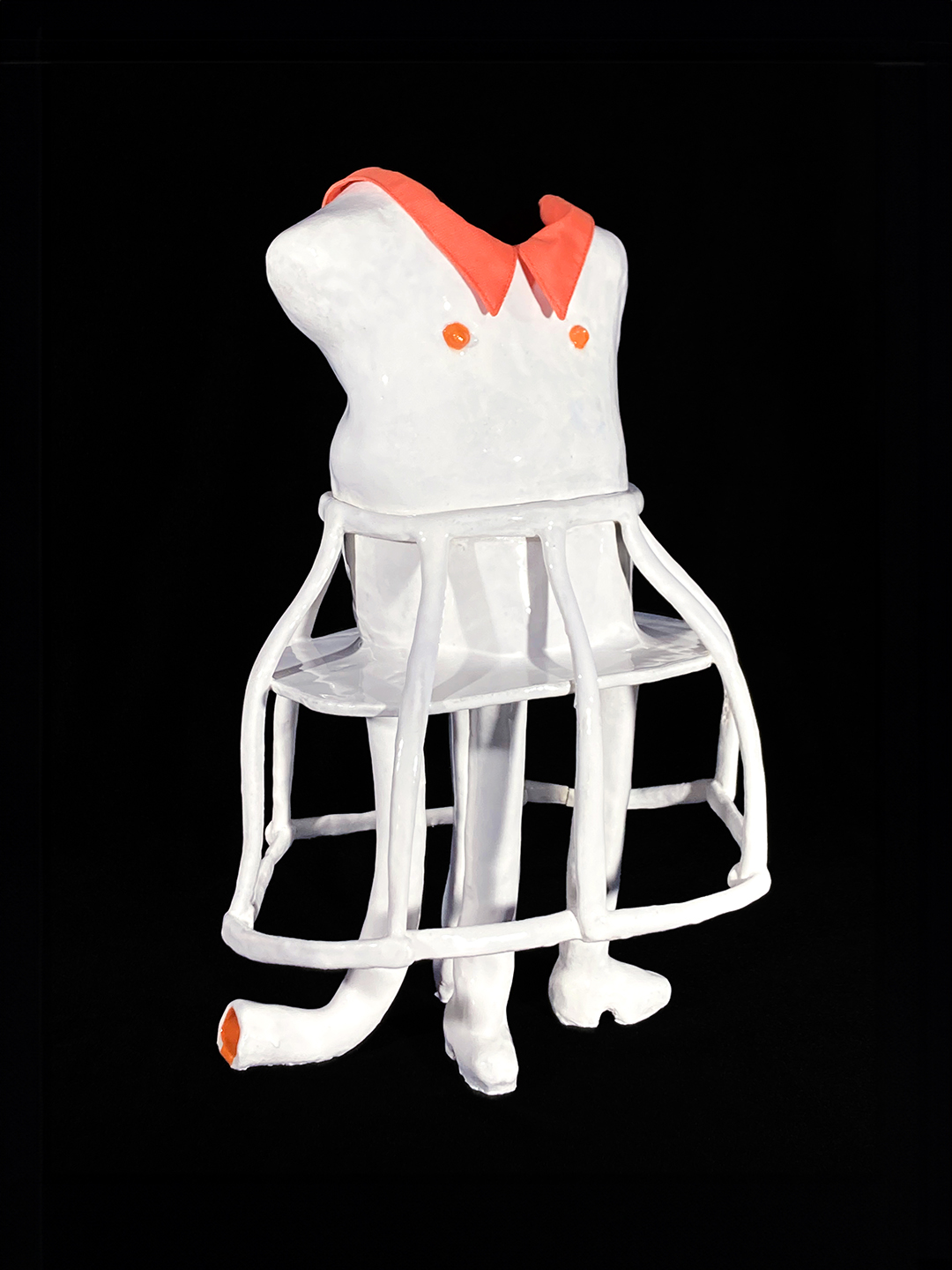
The Long Island City Artists, an art non-profit known as LIC-A, is currently presenting a bold exhibition that brings together artists who work simultaneously in two media not always thought of as compatible. Curator Matt Nolen has gathered a fascinating group of artists from the NYC metropolitan area who work in both clay and drawing–one influencing and bouncing off the other. The synthesis is a fascinating and genre-bending exhibition.
Installation view, Invisible Bodies, at Penn State University (HUB-Robeson Galleries), 2023. Images courtesy of The Border Gallery and HUB-Robeson Galleries
Installation view, Invisible Bodies, at Penn State University (HUB-Robeson Galleries), 2023. Image courtesy of The Border Gallery and HUB-Robeson Galleries.
As one approaches “Art Alley,” part of the Hub-Robeson Galleries at Pennsylvania State University, it is the vibrant green walls that first draw one’s attention. Painted green for the “support for an open immigration system, allowing immigrants to contribute to the nation’s labor force, Invisible Bodies: An Exploration of Migrant Labor Through an Artistic Lens, curated by The Border Gallery and Emireth Herrera Valdes, brings together fifteen artists from diverse backgrounds to contemplate labor, immigration, and identity in the United States.
Thin, translucent layers of shaped and stretched natural latex are mounted onto walls or wooden boards to extend the limits of painting—these are Elena Dahn’s New Bodies, on view at the Buenos Aires-based artist’s first New York exhibition. Hosted by Revolver, a contemporary art venue launched in 2008 by Giancarlo Scaglia in Lima and subsequently in Buenos Aires and on the Lower East Side, the exhibition is an invitation to rethink the relationship between body and painting, performance and mark-making, space and surface.
Ernst Röhm, 1981, Graphite, gouache, marker, and color pencil on paper. 54 3/4 x 47 1/4 inches
Who was Stephane Mandelbaum? A closeted gay man? The child of Holocaust survivors? A liar? A thief? A brilliant artist you’ve never heard of? All of the above and perhaps more.
The Drawing Center is presenting the first-ever show of Mandelbaum’s work in the US, and it is a show that left me gob-smacked. The combination of Mandelbaum’s brilliant drawing, deeply personal vision, and the complexity of his backstory is a tale made for cinema. Born in 1961 to a family of paternal Polish Holocaust survivors and maternal Belgian Armenians, Mandelbaum grew up in the town of Namur, about an hour and a half from Brussels. His Father, Ari, was a well-known painter, and his mother, Pili, was an illustrator. There is no record of siblings. A gifted draftsman from a young age but dyslexic and eccentric, Mandelbaum moved from Namur to Brussels, where he seemed to devote his time to making drawings and engaging in what is termed “petty crime.” He married a woman from Zaire (now called The Democratic Republic of Congo) and lived between the worlds of Belgian Africans, the Belgian crime underworld, and his own artistic imagination.