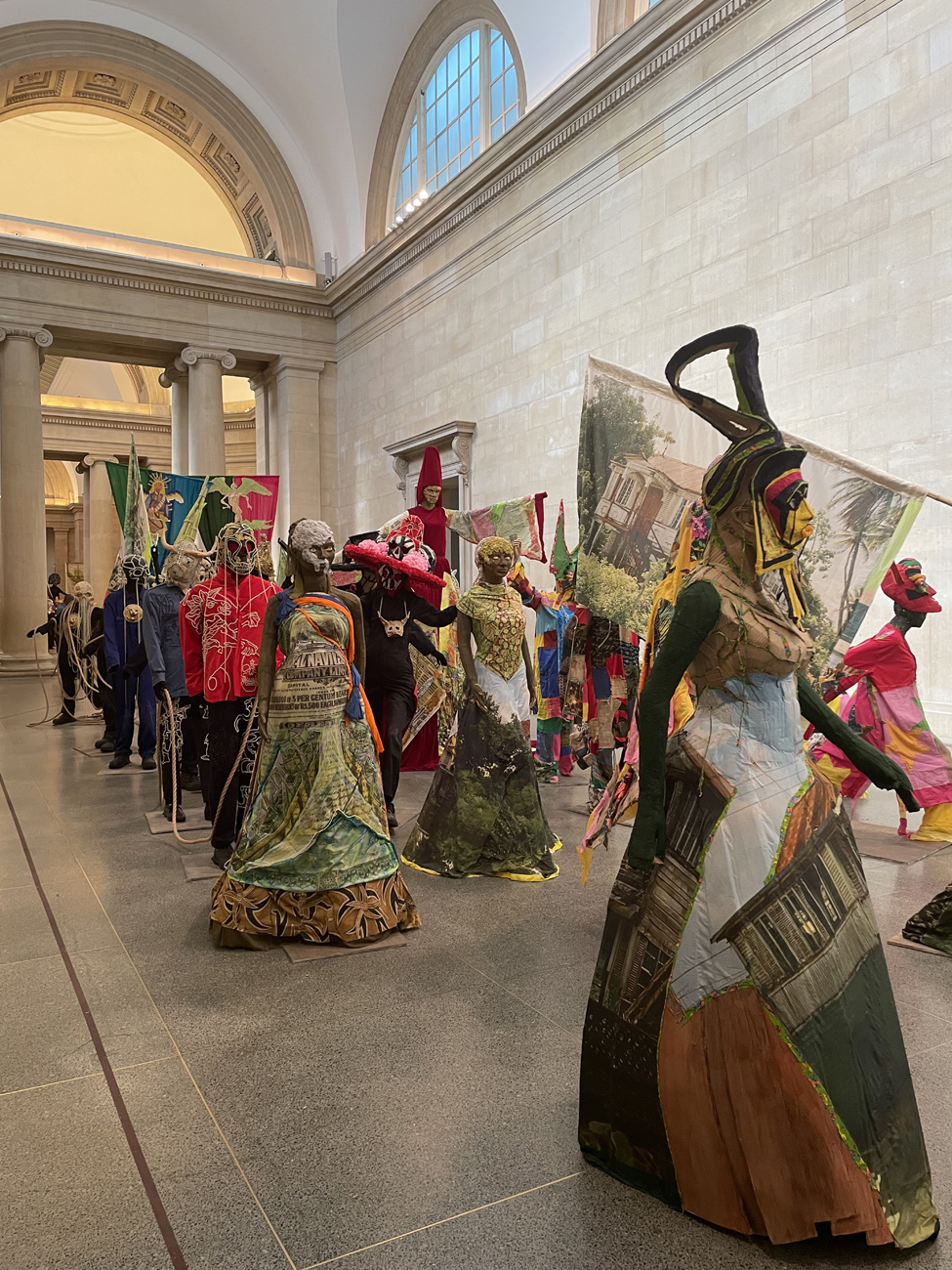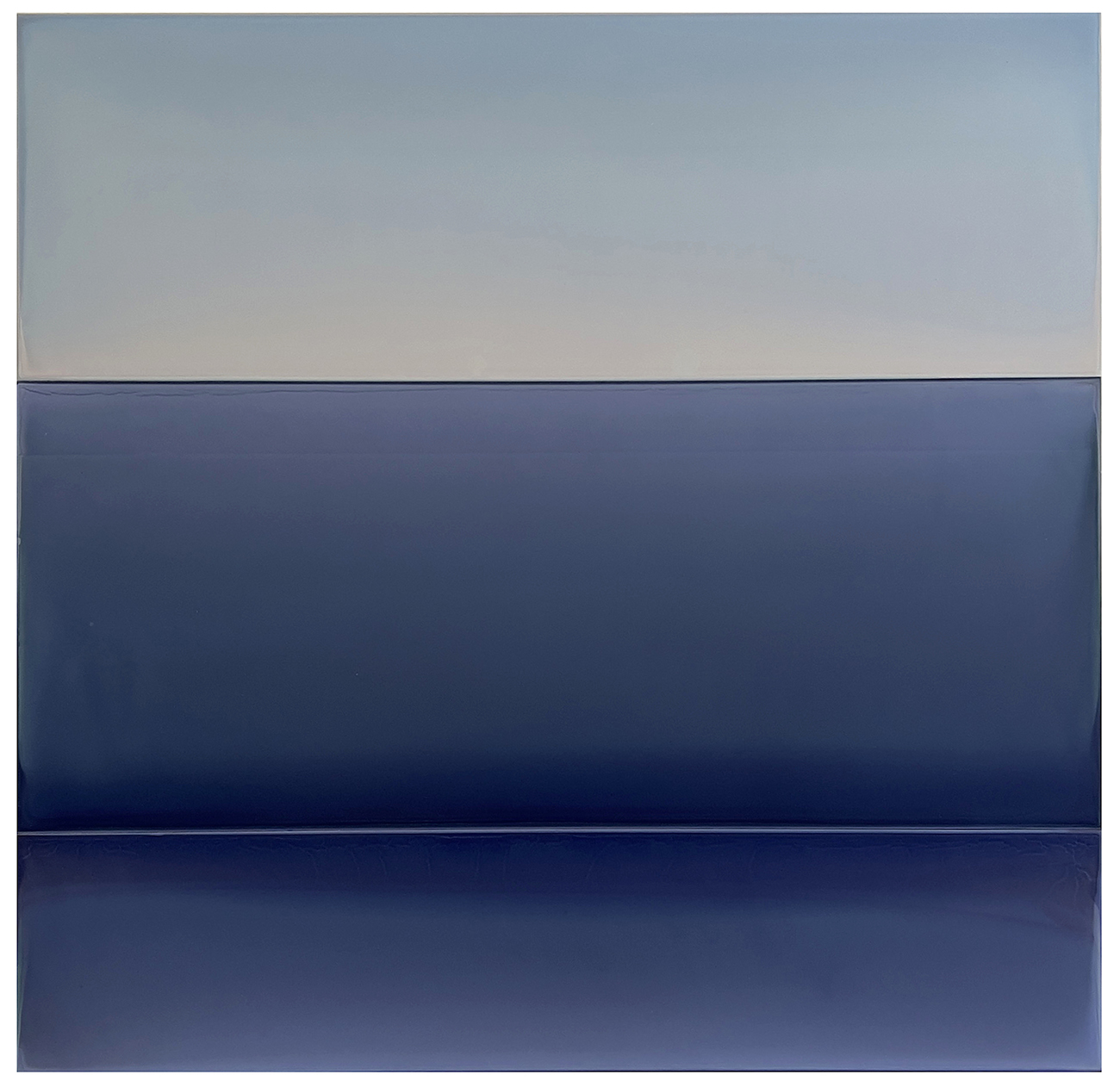
Far from the palatial white cubes of Chelsea or the intimate townhouse spaces of the Upper East Side is a different type of gallery space – one that serves as a reminder of an earlier moment in the art world, and yet persists into the present – the SoHo loft. In his debut solo exhibition, Sam Spillman has created work that probes at this history in In Case Of Sam Spillman at Ulterior Gallery.
The curatorial team held a fascination with exploring and activating the ceiling, corners, and floors of Equity Gallery via the works that comprise Making Sense Without Consensus. Here are 2 examples of this; on the left, Linda King Ferguson’s work stretching downward to the floor; and on the right, Diogo Pimentão’s work installed to live and extend around the corner of a gallery wall.
Now on view at Equity Gallery in the Lower East Side is a notable group exhibition, cogently titled Making Sense Without Consensus, with works by 14 remarkable artists and 3 astute curators at the helm. The exhibition statement says that these artists explore reality through fragmented connections and geometric materiality, “investigating whether the linearity of time is real or if past and future overlap.” In further absorbing what this exhibition might represent, I also want to offer an illuminating quote from The Radicant (2009), an essay by celebrated curator and critic Nicolas Bourriaud. This thought piece provides context for the development of Making Sense Without Consensus:
“In ordinary language, ‘modernizing’ has come to mean reducing cultural and social reality to Western formats. And today, modernism amounts to a form of complicity with colonialism and Eurocentrism. Let us bet on a modernity which, far from absurdly duplicating that of the last century, would be specific to our epoch and would echo its own problematics: an alter modernity …”
Pritika Chowdhry. What the Body Remembers, 2008. Paper pulp, mason stains. 6 ft. x 3 ft. x 10 ft. installed dimensions. All photographs courtesy of the artist.
On India’s 75th year anniversary, the horrors of the Partition cannot be forgotten. Yet despite the atrocities committed against women, their experiences are often excluded from discussions of Partition’s impact. In What the Body Remembers and Queering Mother India, artist Pritika Chowdhry pushes back against this historical erasure. Revisiting two of Chowdhry’s installations for women’s history month, one is struck by the sensitivity and delicacy of her work alongside the urgency of her message.
Nishiki Sugawara-Beda, Installation view of Somewhere Around There, 2022. Photo courtesy of Maggie Pavao
It is perhaps in this state of “not knowing” that we first encounter the works in artist Nishiki Sugawara-Beda’s current solo exhibition Somewhere Around There, on view at the Amos Eno gallery. The exhibition, which presents works from the artist’s KuroKuroShiro series (‘black-black-white’ in Japanese), features dynamic shapes in shaded monochrome that seem to alternately emerge and recede from view. Faced with this shifting visual field, the viewer gradually develops a kind of intimacy with these unknown forms, opening up new possibilities for interpretation and engagement.
Staring at Kathy Butterly’s ceramic sculptures, I am overwhelmed by an urge to reach out and touch them. The marriage of color and form is perfectly wrought, shapes and colors inextricable yet sharply distinct. I want to trace my finger along that delicate whisper thin band of orange in Between Things, and feel the little bumps alongthe rim of Luminious Flow. I want to feel the change between matte and gloss surfaces and the weight of the sculpture in my hand.
From line drawings and cutouts to wall reliefs and sculptures, lines shift forms throughout the group exhibition Drawing a Line at Five Myles. Curator Klaudia Ofwona Draber says she was inspired by the gallery founder Hanne Tierney’s vision to organize a drawing exhibition. Ofwona Draber’s interest in social justice and post-colonialism guided her choice of artists as well as the theme of the exhibition – drawing a line as an action of drawing boundaries, whether to protect personal boundaries in the quietude of one’s own home, or at the heart of a political conflict. “By drawing a line, we protect ourselves, our families and our communities from the violence and inequalities that are happening around us,” says Ofwona Draber.
Kris Grey (NYC) and Barbara Maria Neu (Austria), Miss(ing), 2021. Video (runtime: 4 minutes, 8 seconds), performance (15 minutes) and sculptures. Photos: un/mute team
How can artists unmute themselves and make work in creative dialogue with each other while they experience forced solitude at faraway places? How can collaborative practices be reinvented in social isolation? And how can virtual and chance encounters between strangers can lead to the making of jointly authored images and objects? The un/mute project, initiated by EUNIC New York and Undercurrent, the independent exhibition space in DUMBO, was an attempt to probe these questions by inviting 32 artists to work across borders, languages, and media, while sharing the global experience of the Covid-19 pandemic at distant locations, under varied social circumstances, and in cultural contexts.
On May 13, 2020, in the middle of the global pandemic, the NYU Abu Dhabi Arts Center in the United Arab Emirates hosted a streaming event consisting of a four-and-a-half-hour filmed version of HOLOSCENES, a durational performance installation that was originally presented there live in November of 2016. The event also included a conversation with Lars Jan, artist, writer and project director, as well as members of his team. HOLOSCENES is comprised of performers going about common, every-day tasks while the aquarium in which they are confined fills and empties with water. Although conceived as a commentary on “states of drowning” – rising seas, melting glaciers, intensifying storms, floods, and their impact on daily life – the project takes on additional meaning as we struggle with our own physical and psychological confinements during the great global quarantine.
One finds a simple common thread between the three exhibitions of women artists in Andrew Edlin Gallery this fall 2021: spiritual internal guidance in the artistic process. The work of German artist and known medium healer Agatha Wojciechowsky (1896-1986), curated by Aurelie Bernard Wortsman, is in Spirits Among Us at the entry and main gallery space, while the work of French artist Margot (b. 1982) is in Margot’s Cosmic Sanctuary at the back gallery. The solo presentation of American artist Karla Knight (b. 1958) was at the recent Independent Art Fair in New York City, which briefly overlapped with these two fall season starters at the gallery. Led by their individual connection to the otherworldly, the artists make work that invites viewers to ponder the source of creation and artistic agency.
Daze and Crash for Welling Court Mural Project. Photo by Joe Iurato
A few weeks back, an intergenerational group of five iconic NYC graffiti and street artists descended on Welling Court Mural Project (WCMP) in Astoria, Queens. The latest batch of mid-sized murals to grace this otherwise unassuming treasure trove of paint at the intersection of Main Avenue, 30th Avenue, and Welling Court includes Chris “Daze” Ellis, John “CRASH” Matos, JM Rizzi, Queen Andrea, and Joe Iurato, a world-class lineup whose collective come-up eras span the 1970s into the aughts.