Debbie Hesse: Spatial Paintings

Debbie Hesse, the CT based artist, makes plexiglass sculptural constructions and video installations. Her sculptural installations, or “spatial paintings” are typically made of multiple planar Plexiglas and wood cutout shapes layered to create complex shapes which bring her ideas to life through light and color.

Fellow Travelers at PeepShow Space

Fellow Travelers at PeepShow Space

Photo Story

Fellow Travelers, PeepShow Space’s fifth and final exhibition, features the work of Joshua Rosenblatt, Jason Phillips and William Norton. The three artists reflect on travel, which at this moment is impossible in their lives as they shelter, wait and dream about places that no longer exist, except in memory.

Yvette Molina: Big Bang Votive at the Visual Arts Center of New Jersey

In Dialogue with Yvette Molina

Big Bang Votive, Yvette Molina’s collaborative storytelling art installation has evolved over fifteen weeks, utilizing the Mitzi and Warren Eisenberg Gallery at the Visual Arts Center of New Jersey through January 18th, 2021. Yvette Molina creates an immersive audio-visual experience — accompanied by a 30-minute surround sound composition played on a loop, her installation includes three hundred paintings of starry skies, some with votive symbols of delight or love taken from stories gathered from the public, a work-table with the artist’s materials, and an on-going “story catcher” project involving public participation.

A person sitting in a chair Description automatically generated with medium confidence

Samira Abbassy: Hybrid Iconography

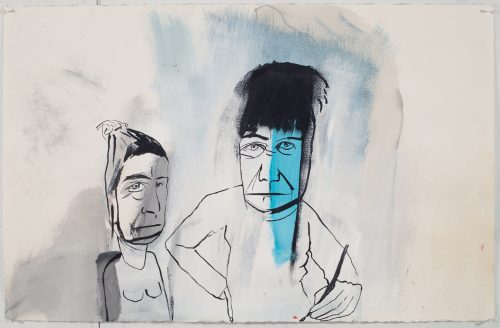
Samira Abbassy’s paintings and drawings portray mysterious iconic figures, primarily female, who inhabit an ambiguous space. While her pictorial world resonates with archetypal imagery from eastern and western cultures, it equally pulsates with an urgent psychological core, creating an invigorating tension which prompts the viewer to search and discover rich layers for meaning.

A picture containing text, indoor, floor, wall Description automatically generated

Private View from Home to Home

In Dialogue with Naomi Lev, Rebecca Pristoop, and Sarah Crown

The Exhibition Private View is a bit like an artist’s game of telephone. Three curators: Sarah Crown, Naomi Lev, Rebecca Pristoop, coordinated the movement of works by seven artists (Aimée Burg, Noa Charuvi, Tamar Ettun, Julia Goldman, KB Jones, Dana Levy, Gabriela Salazar) from home to home of each of the artists. In each new space the works were rehung, re-organized, and displayed in a new environment, often with the addition of the host’s collection of art. I interviewed the curators to find out how they planned and executed this show and how it was recorded and disseminated. In a way this exhibition reversed the traditional structure of personal and private: instead of the public being able to see artworks in a whitebox gallery or museum, which has been made impossible because of the pandemic, we became spectators on an artists private space—we couldn’t be there in person, but via Instagram we were shown more than we usually get to see. These notions of intimacy, personal expression, and a safe space in times of turmoil were central to the exhibition Private View.

Margaret Roleke: Getting a Dialogue Started

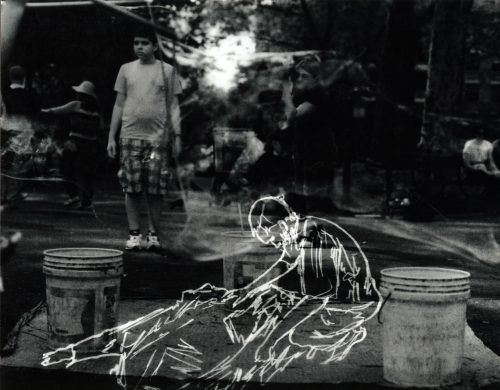
When Margaret Roleke finished her MFA, she was a sculptor and installation artist. From early on she created installations dealing with issues of water, sound and light and after becoming a mother to four children, notions of motherhood and domesticity became central in her work. As her children grew, current political events became increasingly part of her visual expression. For instance, around 2002 she started including toy soldiers in her sculptures, referencing the Iraq war, and also around this time for a public art project in Brewster, NY, she made seating for the day-laborers who were regularly gathering on that site. She continued to make work that spoke to issues that were important to her, mainly gun control, domestic abuse, and immigrant rights. She says she had no intention to be an activist artist, but became one in the course of making art and exploring her true voice — “The Trump presidency led me to march on the streets and register voters, but I feel I can be a better activist when I create work which starts a dialogue on these important subjects, as this seems to be what comes naturally to me,” she says.

More Time Less at Cathouse Proper

In Dialogue with David Dixon

For Cathouse Proper’s second ensemble exhibition, More Time Less, curator and gallery director David Dixon brought together five artists — Zac Hacmon, Elana Herzog, Aga Ousseinov, Tim Simonds, and Nari Ward — whose installations, wall-based work, and sculptures reflect our changing perception of ‘normative time.’ David Dixon describes his curatorial process, gives us a closer tour of this ensemble exhibition, and shares some background on his diverse art practices.

In Accordion Time, Unfolding : A Pandemic Archive at Ursa Gallery

In Dialogue with Alexandra Rutsch Brock

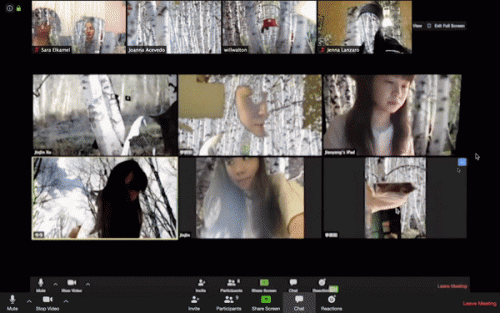
The group exhibition In Accordion Time, Unfolding : A Pandemic Archive marks the opening of Ursa Gallery, an experimental gallery showcasing contemporary art and design located at the historic Arcade Mall in Bridgeport, Connecticut. This art venue was founded by Cris Dam and conceived in collaboration with Dustin Malstrom. Cris was also cofounder of Dam Stultrager in 1998 – one of the earliest galleries in Williamsburg, Brooklyn. Co-curated by Alexandra Rutsch Brock and Patricia Miranda, the exhibition features mail art in the form of accordion-fold books and digital dialogues by the London Calling Collective over the challenging past year. It runs through February 12th, 2021.

A picture containing person, person, outdoor, cellphone Description automatically generated

Michael Sakamoto – Resolving the Unresolvable

In Dialogue with Michael Sakamoto

Michael Sakamoto is an interdisciplinary artist and scholar active in dance, theatre, performance, photography, and media. His solo, ensemble, and visual works have been presented in 15 countries throughout Asia, Europe and North America. Art Spiel had a conversation with him on the alienation of the body; the gender roles and queerness in Butoh, as well the deterritorialization and exotification of non-Western art.