A person smiling in front of a curtain Description automatically generated with low confidence

Dee Shapiro – From Fibonacci to Bathers

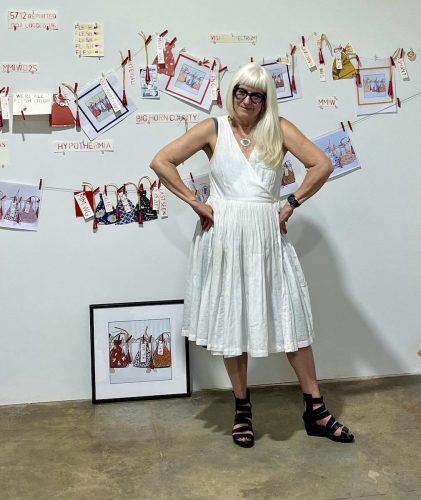
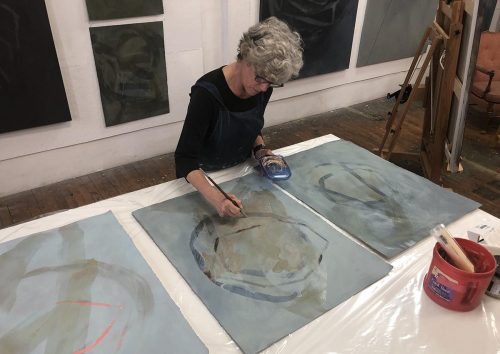
Dee Shapiro’s paintings have evolved over decades of a rigorous thematic and formal search—how colors and shapes can express the intricate relationship between pattern, geometry, and nature through a two- dimensional form? With what appears to be a strong impetus to constantly re-invent her painterly vocabulary, Dee Shapiro’s work keeps us on our toes with each of her series of work, which she sees overall as evoking an alternate reality with absurd connection. From her early Fibonacci progression color coded on graph paper, to her later representational Bathers series–Shapiro’s paintings assert themselves with a life of their own, without a need for any explanation.

A picture containing text Description automatically generated

Wei Jia: The Remembrance of Ink

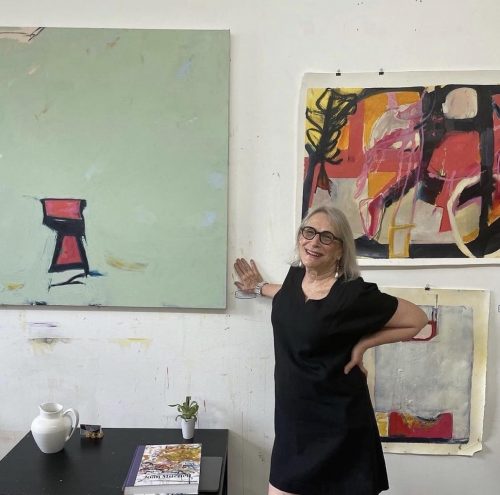
At a certain point in one’s life, they stop making new marks or registering new memories. All that remains is a fluid, ever-changing assemblage of the fragments from the past. I would call it no stagnation: it is rather a moderate manner of growing at a different pace.

A person in a black dress Description automatically generated with low confidence

Chalet Comellas-Baker: Interrogating the Performance of Identity

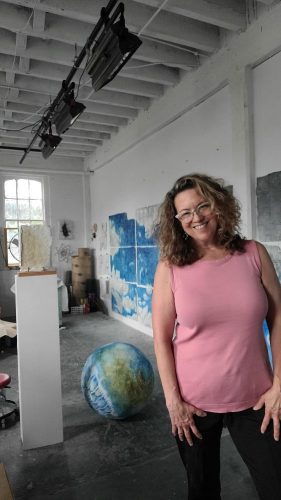
Chalet Comellas-Baker uses video, sound, installation, and print to interrogate memory, environment, and place. The Nashville-based artist is inspired by her Spanish, Cuban and American roots and often references Latin American diasporic histories through her personal lens of assimilation. As the co-owner of Unrequited Leisure, she brings a new dynamic of screen-based artwork with critical and topical investigations into Nashville’s growing art scene.

A picture containing text, transport Description automatically generated

On Water as Polluted Body, Place of Solace, and Life Force

Since June of 2017, artists Jarrod CluckGina R. FurnarisTo LenLeslie Sobel and Rachel Wojnar have been on an intense physical, emotional, spiritual, and art-making journey, which culminated with their MFA Thesis Exhibition, Confluence, on view at the Joseloff Gallery of the Hartford Art School, University of Hartford (Connecticut) from September 10-19, 2020. They are the third cohort to complete the Nomad Interdisciplinary MFA program. Founded by director Carol Padberg in 2015, the program uses an innovative field-based model and offers a curriculum that includes art, ecology, the study of place, indigenous knowledge systems, and technologies. Encompassing two hands-on residencies per year, the Nomad MFA provides courses in El Salvador; New York City; New Mexico; Mexico; Oakland, California; Miami; and Minneapolis.

A person standing in front of a blackboard Description automatically generated with medium confidence

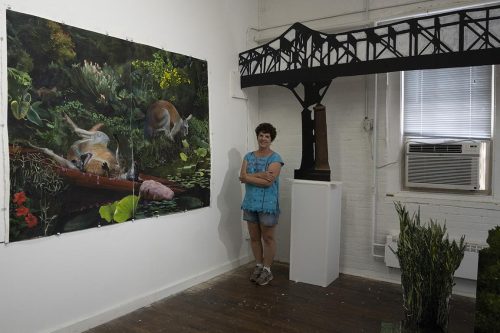
Todd Bartel: an Omni-coupler

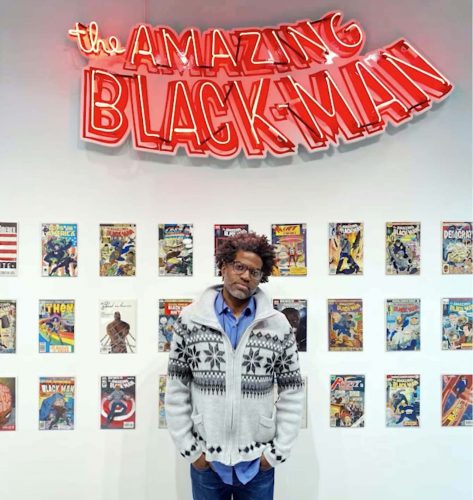
Todd Bartel came to serious collage because of an assignment he received on the first day of his first class as a freshman at RISD. He recalls the desks were strewn with magazines, and as soon as the course started, Professor Hardu Keck gave the students a prompt, “Create five collages that work with the following sentence: Surrealism is the chance happening of finding an umbrella and a sewing machine on a dissecting table.” Keck did not mention he was quoting Andre Breton, who was quoting Comte de Lautréamont (Isidore Lucien Ducasse). He expected his students to work with the strangeness of visual combination and found imagery. That was Todd Bartel’s introduction to Surrealism and chance coupling. He fell in love with collage immediately, coming up with forty-five collages by the first week. One of the key elements that draws him to collage is that it can involve a vast array of analog and digital technologies. “I consider myself an Omni-coupler,” he says.

Dream-Restart-Experience at PS122 Gallery

Annette Cords and Becky Brown In Conversation

The two-person show Dream-Restart-Experience at PS122 features collaborative and individual works by Annette Cords and Becky Brown. The two artists’ collaboration resulted in a wallpaper using three original alphabets, and vinyl lettering mounted on the gallery windows. Cords’ tapestries interlace traditional weave structures with a twist—involving urban mark-making and found text. Brown’s paintings embody artifacts of online culture while questioning their value. The show runs through August 22nd, 2021.

Background pattern Description automatically generated

The Ocean Inside

Dutch-Canadian printmaker Eveline Kolijn grew up in the Caribbean where she developed an enduring interest in natural history and the environment, as well as a love of the ocean. Having spent a great deal of her childhood scuba diving in the coral reefs, she originally thought of becoming a marine biologist before her life took her in another direction. 

Instituting The Re Institute in Millerton

In Dialogue with Henry Klimowicz, founder and director

The Re Institute is an extension of Henry Klimowicz’s studio, a very large 1960s dairy barn outside of Millerton, New York. About 11 years ago sculptor Henry Klimowicz started the gallery as a response to living in the “center of nowhere”, as he puts it. The artist says that the gallery allows him to have extended working relationships with other artists and their work. “I try not to know what a show will be about before it opens and I get to spend the length of the exhibition becoming aware of all of each show’s nuances,” he says about his curatorial process. A normal season at Re Institute includes 4 to 5 shows, which mostly feature 2 to 3 artists showing in the large space upstairs and another person downstairs. “I try to get each artist to have a specific reason for showing in the gallery outside of the possibility of selling work,” he says. This fits his vision of Re Institute as a non-profit institution. It’s important for him that the featured artists will find reasons to use the space uniquely. “There has to be something in the process of showing an artist that brings depth to the artist’s understanding of their own work or the process of exhibiting their work,” he says. These different ways of interacting with each artist have become the most important aspect of the space for him.

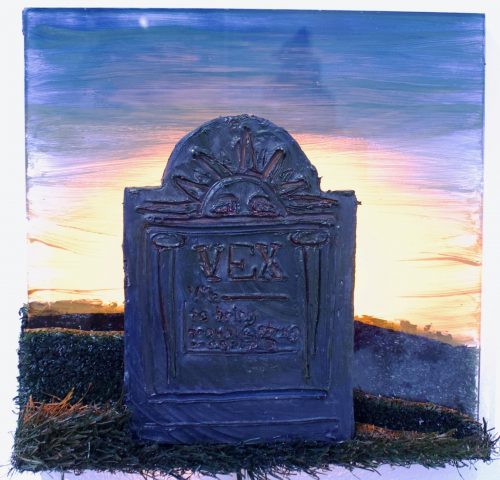
ilfautseméfierdesmots.jpg

Let the silence take over: On words, inner compass, and patience

Looking at Art

To make a painting is not easy. To look at a painting is not an easy matter either, as it requires the viewer’s disposition and willingness to engage with it beyond words and labeling. Our brains like to pin things down, using minimum resources to move on to the next task as quickly as possible. They latch on to words. Yet the moment words enter our minds, we’re not really looking anymore.